On today’s show, Fed & Fit listener Sam joins me on the show to talk about the unsung benefits of taking a purposeful break from working out.
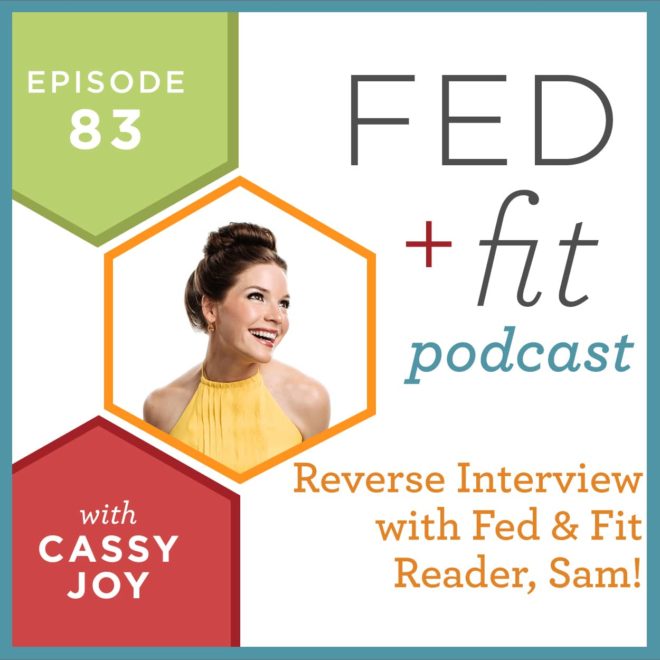
We’re back with our 83rd episode of the Fed+Fit Podcast! Remember to check back every Monday for a new episode and be sure to subscribe on iTunes!
Find us HERE on iTunes and be sure to “subscribe.”
[powerpress]
Episode 83 Links
- Check out Aaptiv HERE and be sure to use the code “FEDANDFIT” at checkout for a FREE 30-days!
Episode 83 Transcription
Today’s show is brought to you by Aaptiv! Aaptiv is a fabulous app and robust online community that allows you access to top notch, motivating personal trainers who guide you through a workout timed to your choosing with fun, perfectly synchronized music. Whether you want to squeeze in a butt-kicking, 10-minute, no equipment workout before lunch, or launch a 5K interactive training guide, Aaptiv has you covered.
Speaking from experience, Aaptiv is not just another fitness app. I was blown away by the options and the fun workout experience. Essentially like Netflix for fitness, Aaptiv gives members unlimited access to their entire bank of high-end, trainer-led workout classes. If you’re looking for fresh, high quality, on the go, motivating workouts that adapt to your lifestyle, I highly recommend Aaptiv.
Also, because they’re just the darn best, Aaptiv is even offering Fed and Fit listeners a free 30-day trial. So when you sign up for a monthly subscription at www.Aaptiv.com; that’s Aaptiv.com, be sure to enter the promo code FEDANDFIT, one word, at checkout, and your first 30 days are on the house.
Cassy Joy: Welcome back again to another episode of the Fed and Fit podcast. I am excited today to bring another; let’s call them reverse interview, shall we? {laughs} I don’t know what to call them. The lovely Sam from Milwaukee, Wisconsin, and she graciously reminded me which state Milwaukee is in {laughs} so I could say that, is on the line today. She wrote me with some great questions, and I told her they were great questions, and I said; I knew that other folks probably had similar questions, or at least would love to hear the answer. So we’re going to have an awesome conversation today! Again, we’re flying by the seat of our pants. I did not refresh myself on all of her questions, so she’s going to ask them and we’re going to have just a live conversation. It’s going to be really fun; welcome to the show, Sam!
Sam: Yay, I’m excited! Thank you so much for having me.
Cassy Joy: Oh my gosh, the pleasure is all mine. Thank you for making time to come on and chat with me live. Break out of the email chain. {laughs}
Sam: Of course, I’m excited. This is fun.
Cassy Joy: Me too. Well, I’m going to go ahead and give you the baton; it’s your show. Take it away.
Sam: Alright; so just kind of going back to when I first emailed you. I kind of remember in the past you mentioned that you would sometimes take one to two full weeks off from working out, and I just kind of wanted to understand more about that, what the reasons are for doing that, what benefits you see from doing it. I feel like a lot of people struggle with taking time off from working out, and I just wonder what a full two weeks does for you. If you could just explain more about your experience with that?
Cassy Joy: Yeah, that’s a great question! That’s why I was like; oh, please come and ask that on the recording. That’s an awesome question. It’s something I haven’t touched on a bunch, and I kind of want to talk about it some more. You know, I think that it’s important to take breaks from everything. It’s important to cycle things in and out, right. If we look at food; I do this a lot. I answer all the way around the question, and then we’re going swoop right in and talk about it. {laughs}
Sam: Perfect.
Cassy Joy: So when we look at foods, right? Certain foods, produce, they all have seasons. And I like to think that us as human beings are pretty much designed to fit our world, our natural world, similarly. We’re supposed to have seasons. We’re supposed to seasonally have a whole bunch of starches from squash; you know, winter squash in the winter time. And it’s great to have berries in the summer, and it’s awesome to have; oh gosh, what are the other seasons? Berries and squash, those are the ones I track apparently! {laughing}
But you know what I mean. You go into the grocery store and you see the things that are at the center aisles or at the farmer’s market, all the produce that’s on sale at certain times of the year, certain times kale has done really well. You’re going to find that’s when it’s going to be the most nutrient dense, the most affordable, that’s really where we want to try to surround ourselves, try to eat as many of those foods as possible, because we’re going to get the most bang for our buck, and we’re going to feel great from it. And it’s good to have kind of a high dosage of those micronutrients present in those foods kind of in waves, in seasons so to speak, throughout the year.
So in that same vein, I think when it comes to exerting ourselves in physical activities, just like working out or running or Crossfit or man; I don’t know, yoga. My yoga teacher wants me to yoga every day, so. {laughs} She would beg to differ. But there are times when it does really well to take a break, whether that’s during the week, you know, if ya’ll are familiar with my book, the Fed and Fit Book, I talk about fitness I really emphasize the importance of having rest days during the week. One to two, right? Two is ideal. One, if you’re only taking one then maybe your second one is just a lighter day of working out. But it’s important to give our body some time to rest and recover during the week so we’re not constantly in this high state of stress. Because working out is a stress on our bodies, right. Just like preparing for final exams is a stress, and just like writing a book is a stress, and hosting your in-laws can be a stress. As far as our bodies are concerned, while there are certain benefits from working out that are unique and wonderful, and important, it is still a stressor.
So if you’re looking at your total load, let’s just say for the week, again. I’ll get to answering your question. But if we look at the total load for a week, Sam and I are video Skyping so I’m using a lot of hand motions right now {laughing}. The podcast listeners can’t see. I talk with my hands a lot, which is funny that it’s a podcast as my main medium. But if we look at the total load for a week, you kind of want to see that you’re balancing out your total stress evenly; that you’re not bombarding yourself with too much. Too much working out, or too many dinners that you’re hosting, or too many finals. You’re going to have to kind of balance things out.
When I was writing the book, for example, I worked out less because I wanted to try to, again, strike a balance between all of that stuff. I slept more, I drank more water, I ate healthier, I didn’t indulge as much because I knew that I was putting my body through a lot with the stress of writing a book. So that’s kind of what we’re looking at; balancing out stress and giving ourselves time to rest and recover through the week.
Now if we look; take that week, and we expand it for the sake of a year. Or even 6 months, right? Let’s say a year, that’s easier. We look at our physical fitness activities on a calendar year, right? We’ve got January through December. We kind of want to look at it and decide; is there going to be a time in that year where it makes sense to give ourselves a break? Where it makes sense to give ourselves some rest. Just like how we have seasons with foods, and it would do well for us to also think of physical activity as having a season, as well. Maybe not necessarily we have; because when you think of season, like basketball season. There are times when athletes are working out really rigorously; I’m a Texas girl, so we follow college football a lot. And there are times when those guys, those Aggies, are working out, and they’re getting really ready, and they’re spending a lot of time conditioning for the football season, and then they take a considerable break.
I’m not saying we need to take a huge break off that’s months long, but I think a couple of weeks every once in a while is going to do really, really well for our bodies. We’re going to respond well. I’ve been crossfitting for over 8 years now; which seems like a long time. My coach told me that the other day; the other day. It was a while ago. But I was doing a nutrition seminar at our gym, and he introduced me. He was like, “I’ve looked up the records and I saw that you’ve been a client for 8 years.” It’s like; I cannot believe that, that’s a long time. It does not feel that long. But in those 8 years, knock on wood, I’ve never had a serious injury. And I think that’s because when I got to the point that I felt exhausted. If I felt really tired in constantly working out; I listened to my body. I think that’s a really important tool when it comes to being a nutrient seeker; trying to let your body tell you which foods you should be eating, whether it’s high carb, low carb, whatever that is. I think it’s also important to be an overall physical wellness seeker, as well, and we listen to our bodies.
If your knee, all of a sudden, really starts to hurt then maybe the IT band is really tight and maybe we need to start rolling out some of our glutes. Try to listen to your body, and if there’s a chronic discomfort; I won’t necessarily call it a pain yet, but if there’s a chronic discomfort, that rolling out and trying to exercise and stretch out isn’t working, then I think it’s important to take some time off. Let your body rest and recover; and maybe that’s a week, maybe it’s two weeks. And it’s not going to feel great coming back. Especially if it is something like a Crossfit, or a run, or something like that. It’s going to hurt coming back at first. You’re going to feel like you’re starting all over again, but you’re not. It’s not very pleasant coming back, but the benefits of maybe possibly preventing serious injury are huge. So that’s really the main reason why. I think it’s important to let our bodies rest and recover; kind of view ourselves as having seasons, you know. Maybe our off seasons is much shorter compared to our on-season, but it’s ok to take that time off. Especially if it’s centered around a really stressful time in your life.
Sam: Yeah, that totally makes sense. And actually I had first approached you with this question because I am dealing with an injury right now, and I think it’s an overuse injury. It’s nothing serious or anything like that. But yeah, that definitely. I think I should just hang up now, and take some time off from Crossfit {laughs}.
Cassy Joy: Oh man, you’re going to be like; go up to your coach, “so this girl Cassy told me that I should take some time off.” They’re going to be like, “Never listen to her again!” No, I really think it’s important, and there are a lot of people; it’s really putting the ball in your court. I’ve seen so many athletes, especially in the vein of Crossfit, because you and I are both crossfitters. Especially in the vein of Crossfit, and I know listeners here can probably identify with this. We see people who injure themselves, and they are forced to take 6 weeks off, or whatever it is. 8 weeks off; 12 weeks off, depending on the injury, because they thought they could just push it. And they thought they could just ignore it and maybe it would go away, because they’re strong and healthy. But you get to a point where bodies are not invincible. Something is going to give. And taking strategic time off; taking two weeks off, deciding when you want to do it, so that’s empowering in and of itself, right? Because then you are saying, “Yeah, I’m taking these next two weeks off.” Not, you’re at the mercy of this injury and whenever it decided to heal is when you can go back. So you’re in control, you get to take the time off; and you’re trading two weeks instead of a possible out of your control 6 weeks, or 8 weeks, or who knows how long.
So it’s really just; I view it as injury prevention. I also kind of look at it from the holistic point, just trying to reduce total load overall, stressors on our bodies. But yeah, I think that’s a great question and I think it’s an important thing to do. On the weekly basis, taking rest days. It’s important to not be a hero. You cannot go; well, I don’t. I personally do not go to the gym and give it 100% every time I’m there. I give it 100%; I think I wrote about this in the book. But I give 100% one, maybe two days. And then outside of that; let’s say we’re looking at 4 days out of the week. I give 100% one day, maybe 90% day 2, and then maybe 50-60% on those other, days 3 and 4. Because I really just want to go; you’re going to get a lot of benefit showing up, going through the motions, and you give yourself considerable rest. And that’s how I’ve been able to do this stuff a very long time. I really believe that. Plus rolling in mixed fitness stuff; integrating yoga and things like that.
Sam: So, I guess; so say you decide you’re going to take those two weeks off. I guess a follow up question to that; so for me personally, I coach Crossfit part time, and my brother is the owner of the gym, and my family is there, my mom, I work out with her every time I go in, and my sister.
Cassy Joy: That’s awesome!
Sam: Everyone is there; it’s a family thing, and Crossfit in general is just community. So for me to be like; ok, I’m going to take these two weeks off. Well, I’m left feeling left out of things, you know? You miss that time with family, or with friends at the gym. So I guess if you can speak to that; how do you deal with the feeling of being left out if you’re not going to the gym? And I guess this is specifically more speaking to a Crossfit type thing where it’s community based and you have that camaraderie with people that you’re seeing there; you know? So I think that’s part of the issue; and kind of just what to do with your time, then, and you’re feeling left out, getting behind physically, and worrying, “Oh, am I going to gain weight now?” You know? So I feel like all that stuff just makes it so much more complex.
Cassy Joy: It is. It’s not easy. I mean, I get it. I feel you; I know what you’re saying. That’s 80% of the reason that I love Crossfit as much as I do; because of the friends and you’re all miserable together and the bond building {laughs}. It is; it’s the community. That’s really what keeps most people coming back to it. I mean, how to deal with that. I don’t know if you have the time; you could go to the gym, as a thought, just go and hang out, and maybe there are people who; you know, what if you go and you just take that time to, I don’t know if y’all have foam rollers or anything like that, and you just roll out. Or you do something where you can be just kind of low impact; I don’t know if you have an Airdyne. You could just sit on an Airdyne, you know, and just kind of sit there, move your body. Be there during class, still have that time, but take things really easy, and tell yourself you’re going to show; I have friends who do that. They still come to their classes, you know. They still show up to that 9 a.m. class because they want to be there with the group, but they’re going to sit on the Airdyne for 30 minutes, and then they’re going to roll out for 30 minutes. So maybe that’s something that you could possibly incorporate. Just show up, still keep it as part of your schedule, and still be there with them. You still are going to miss out on the workout; but, and kind of commiserate kind of vibes; but at least you’re there with them. So that might be some way to meet in the middle.
And as far as worrying about gaining weight; I think if you’re really listening to your body, at first you’re probably going to; if you’re not exerting yourself as hard, you probably won’t need as much food. But that doesn’t mean that you should forcibly cut back. I think that if you’re just listening to when you’re hungry and how much food you really want, you’ll be able to gauge that very naturally. So don’t be afraid of that. I’m definitely not a low-carb proponent; I eat very high carb, healthy carbs, so you might find that you don’t want or grave as many carbohydrates during that time off, as well. But other than that, I think you should be definitely fine. Just listen to your body, listen to what you need. Keep drinking plenty of water. Keep sleeping well. Don’t try to replace the stress of working out with the stress of something else. Really consider this a time to recover. Treat it like that. Be very; almost think of it as a very therapeutic time off, and really be intentional. But I know; the camaraderie piece is hard.
Sam: Yeah.
Cassy Joy: That is. And you’re going to figure it out. You will. That’s so fun; you’re whole family is together. That’s awesome.
Sam: Yeah. It’s super fun. Ok, well I guess that kind of leads into another thing I wanted to talk about. So I guess to part of taking time off is then you’re worried that you’re not going to be staying in line with those other people that you usually lift with or things like that. They’re getting stronger, and you’re taking a step back, and that’s just hard to see. Obviously, you’re encouraging your friends and you want them to be doing their best and getting better, but you just feel kind of bad that you’re not doing the same. So I guess what are your thoughts; and this might be a total tangent off thing. But just thoughts on comparing yourself to others? Because I also think that is a big thing; and even just looking at the taking time from working out perspective; because you’re worried about comparing yourself to others and you see all this stuff on social media that’s saying work out all the time and no rest days; you know what I mean? So I guess what are your thoughts on just comparison in general in working out, eating, maybe that’s a really big question. {laughs}
Cassy Joy: No, it is. It’s a huge question. It’s such a huge topic.
Sam: Yeah.
Cassy Joy: You and I could sit down together and put together a whole book on it. You know; I think when you see on social media and someone says, “No rest days,” and “Hustle is the answer to everything,” or “Work harder.” I think that that works for a hot minute. But it doesn’t really speak to longevity. It doesn’t really speak to a long-term plan, right? If you’re really looking for long-term health and wellness, you want to keep being able to show up at Crossfit and feel really good, and be able to perform at a really good level for years. You’re not just in it for a hot minute. You’re in it for the long term. I think that knowing that your goals are in line with that will help you make decisions from there. Right? Because people who are looking for short term gains are going to have short term results. If you’re looking for long term gains, you’re going to have long term results.
So as far as social media goes; let’s just check that one off the list. I think that; and I also think a lot of that is smoke and mirrors. You don’t really know what people actually do. A lot of people; I will daylight the heck out of it. A lot of people; there’s a science. They know that if they put something up that says, “No rest days!” or “Just hustle harder!” It’s going to get a lot of traction. And it’s going to attract a bunch of people who are wanting short term results, and those people posting it probably have a short term result product to sell. You know? In some way or form, whatever it is, they’re trying to sell something. Maybe it’s not a physical product, maybe it’s an eBook, maybe they’re trying to build a brand around short term results; whatever it is, that’s what they’re selling. I think being aware of what folks are selling, and they’re using marketing tactics that they know work. They may not actually do that themselves. I think being aware of that is good.
Now, as far as not comparing yourself to others, that’s hard. It really is hard. So I, in the gym, there was this girl. I love telling this story. Her name is Rachel. I have no idea if she listens to this show or not, but she’s awesome. She’s like one of the most amazing lifters I’ve ever worked with ever. And I remember she showed up; I go to Elite Crossfit in San Antonio; she showed up at one of our classes. I think it was in 2012, maybe it was 2013, I don’t remember when it was. We were doing overhead squats that day. And I am not by any means; I’m not an extreme athlete, you know. I am highly coached, and I can get through movements really well, and I can probably move more weight because I understand the movements, and the kinetic energy and things like that. But I’m not really, really strong. That’s not my body type.
Anyway, she shows up at this one class, and we’re doing overhead squats and she was just starting; she was brand new. And she goes; I think I overhead squatted like 95 pounds, and I was really proud of myself. Maybe it was 100 pounds; maybe it was 3 digits, I think that’s what I did. It was very memorable. And she’s like, “Wow, you are so strong. I don’t think I’ll ever get to that point.” And I was like, “Sister, give you two months, and you’re going to pass me up.” {laughs} And it may not have been two months, but now, she has tripled all of my max numbers; almost tripled a bunch of them. She’s at least doubled my dead lift, she’s just amazing. So you know, I think everybody is on their own journey, everybody is on their own path. If I worried about comparing myself to people, then I would probably just give up and not show up to Crossfit, because I’m not super strong. For the amount of time that I’ve put into this sport, the weight that I’m moving doesn’t reflect it. But what it does reflect is my long-term goals. The fact that I am strong, and I’m focused. I have really strong bones, I have a really healthy skeletal structure and muscle structure that does really wonderful things for me in my overall health. And, I’m able to keep up with my friends in the classes. It doesn’t necessarily mean that I don’t stop and I don’t cheer them on, because I do.
I don’t know; that’s tricky. It is tricky, because it’s really just a switch in your brain from; honestly, cheering somebody on, and not thinking, “What does that mean about me?” It is. That’s tricky.
Sam: Yeah. And that kind of actually brings me to another point that I wouldn’t mind chatting about.
Cassy Joy: Yeah.
Sam: So, how do you stick to your goals in the gym? So, goals change a lot, and if you’ve been doing Crossfit for 8 years, I’ve been doing it for like 4 years. I mean, my goals have definitely changed throughout that time, and sometimes you find coaches that just want to push you too much, and they just don’t understand why you’re there and what your goals are. That could be that you want to lift super heavy and get your one-rep maxes and things like that, which may have been my goal in the past, to now where maybe wanting to go lighter and just do the movements really well and get a good workout in. So I don’t know if you can talk to that at all as far as just sticking to your goals in the gym, kind of.
Cassy Joy: Yeah. You know, it helps to; there’s two ways, I think to kind of help with that. First, I would say communicate to your coaches and just be really clear with them. Maybe you even send it to your brother, who owns the gym. Maybe even having a goal setting session, or chat with him about possibly orchestrating one for the whole gym. That’s something that my gym did a while ago, and it was just really eye opening, because their members got to write down their goals. It was 5 questions; it was nothing extreme, but then the coaches who coach them at their classes got to read them and understand and then be able to better coach them specific to what their goals are.
And that might have been a safe space to say, “I don’t really want to top my one-rep maxes anymore. I’m happy with my numbers.” And I think this was a realization that I came to two years ago; I was like, I think my days of PRs are behind me. They are; and I’m ok with it. I’m ok with it. I can still hit most of those numbers, but I’m at that number. I’m at that critical mass where something drastic would have to change for me to go up another level and I’m so happy where I’m at. So I think communicating with your coaches what your goals are helps, even in a very non-scary situation like maybe a goal setting sheet.
And then second; I would recommend working out with people who are going to be kind of in line with where you’re at. I changed classes. I started going to a different time to workout with this one group of ladies. I bring up the book a lot because it was just this searing thing that happened. {laughs} It was like a brand on my timeline of life. But, I remember when I was working on the book, I was working out at this 5 p.m. 6 p.m. class, and that’s where the freaking hustlers show up to that class, and I wanted to crush it. Because that’s in me; I want to be able to show up and just crush the workout and give it my all. And then I was beat; I was done. I was so exhausted. I know I was making myself more susceptible and prone to injury because I was exerting myself too much, and I was working too hard at the same time. So I started going at this 9 a.m. class where the girls; {laughs} there’s this one girl in that class I remember showing up the first week and we were doing kettlebell swings or something like that, and I picked up a 35-pound kettlebell, and she was like, “who are you trying to impress?” {laughing}
So I put it back and got a 23 pound. And that’s kind of a joke; it’s the opposite of what we think of as encouragement in the gym, right? We think that we should encourage everybody to lift heavier and move heavier weights; but I had talked to them just casually about stuff, and she’s like, “Who are you trying to impress? Go grab that lighter kettlebell.” And I did, and I did that for a while, and it was exactly what my body needed at that point in time.
So I would say, communicate your goals to your coaches, maybe you get really clear on them first so you can communicate them really eloquently. Or just have a conversation with them. And then I would say; maybe think about working out with people who are going to kind of support you in that regard.
Sam: Yeah, I think those are great ideas. I’ve definitely; you know, when I’m coaching, I’ve expressed to my classes that it’s kind of chose your own adventure with my groups; just whatever works for you is what I think you should be doing. So yeah, I think it’s really good to communicate that.
Cassy Joy: That’s awesome.
Sam: And be upfront, and then everybody’s on the same page. And even if you think someone does have more potential to be doing more weight or whatever it may be; if you know that’s not what they’re there for, then it’s just a better situation for everyone.
Cassy Joy: Yeah. It sounds like you coach with a lot of empathy. I think that’s really great; that’s really important. Your athlete’s probably really appreciate it. Awesome; good questions. Do you have any more? I don’t even know what time it is.
Sam: I mean, I could talk to you for days.
Cassy Joy: Oh, we are at time, aren’t we. {laughs}
Sam: I know. I’m like; I’m looking for another question.
Cassy Joy: Let’s squeeze in one more. Do you have another one that you want to wrap up with?
Sam: Should I; I’ll just do a quick one?
Cassy Joy: Go for it.
Sam: Ok. This is just for me, for fun, just to ask.
Cassy Joy: Ok; good!
Sam: What is the favorite part of your job?
Cassy Joy: My favorite part of my job; this.
Sam: This? {laughs}
Cassy Joy: I’m not even joking. I’m not even joking. Talking to readers, listeners, I don’t know. Being able to interact with you guys; that’s why I love Snapchat so much. I will never close my Snapchat chat. {laughs} Snapchat chat.
Sam: Good.
Cassy Joy: That was a mouthful. But you know, I just love talking. I love interacting, I love getting to know people. I’m a people person, and it is just really ironic that I chose a job that is me and my computer at home. Like what is up with that? I don’t have an office to go and hug on people and wish them happy birthday and bake them paleo friendly birthday cupcakes. Like, that’s not a part of my job, and that’s kind of sad. So this gives me life. Book tour, going out in front of people, and chatting, and getting to know folks, and seeing your beautiful face and hearing your story and what you’re up to, all the wonderful things. I mean, that’s just my favorite part of this job; it’s the best part in the whole wide world.
Sam: I so appreciate that, because you’re; what you’re doing and actually communicating with people that follow you. I’m sure I speak for everyone; it’s so appreciated. I bragged to my friends, and I’m like, “Oh, I just made this recipe from her book, and she messaged me back on Snapchat!”
Cassy Joy: {laughs}
Sam: It’s so cool!
Cassy Joy: I love it.
Sam: It is. It’s like, you’re an inspiration to people but the fact that you’re actually interacting with them, too, just makes it so much more approachable and just everything. It’s so cool. Thank you so much for everything.
Cassy Joy: Oh my gosh, Sam, thank you so much! That’s so kind! That just made my whole day. Thank you. That’s really sweet. This is awesome. I think you’re going to pick the right path, you’re going to figure out what’s best, and even if it’s not a strict two weeks off, or whatever the time is, I think just know that it’s ok whatever you choose. It will be fine. You’ll be fine. And you know what; I bet, I’ve taken longer than two weeks off and come back, and I was surprised by how quickly I bounced back. I didn’t lose a lot of weight in my lifts like I thought I would. So anyways. I had to throw that in there.
Awesome! It was so good talking with you, thanks for coming on. I’m sure people; I know people probably fell in love with Sam from Milwaukee show {laughs}.
Sam: We’ll see.
Cassy Joy: That’s awesome. Well thanks again; good luck with everything. Keep me posted.
Sam: Will do.
Cassy Joy: Keep snapchatting me. And I love it; I really do. If my husband were here, he’d tell you; every time I get a Snapchat I’m like; “Look!” {laughing} So it goes both ways. Well thanks again for joining. And all you listeners, thanks for listening in. we’ll be back again next week.