On today’s episode, I’m joined by TJ Anderson to talk about his upcoming book: The Art of Health Hacking – How to Elevate Your State of Health & Performance, Stress Less, & Build Healthy Habits That Matter.
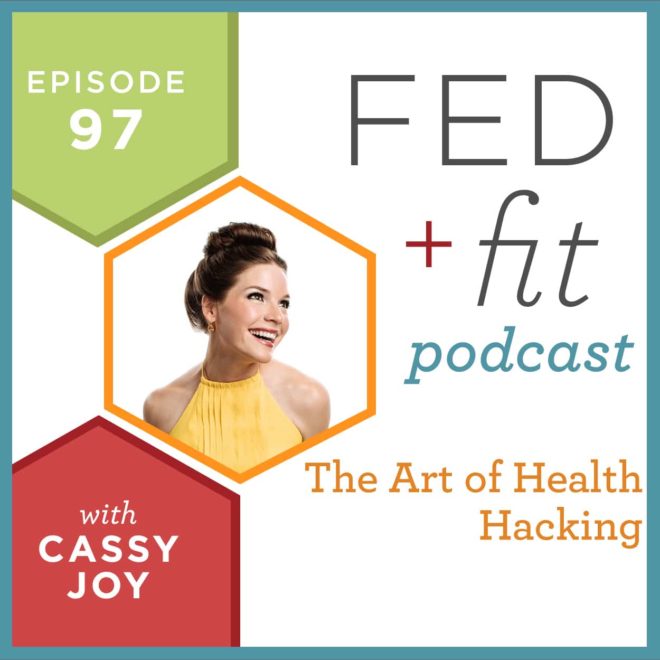
We’re back with our 97th episode of the Fed+Fit Podcast! Remember to check back every Monday for a new episode and be sure to subscribe on iTunes!
Find us HERE on iTunes and be sure to “subscribe.”
[powerpress]
Episode 97 Sponsors
- Aaptiv – be sure to enter the promo code “fedandfit” (one word) at checkout, and your first 30 days are on the house!
- PrepDish – get 2 *FREE* weeks of Paleo/gluten-free meal plans with the code “FEDANDFIT” by clicking HERE!
Episode 97 Links
- Check out TJ’s book project by clicking HERE.
Episode 97 Transcription
Today’s show is brought to you by Aaptiv! Aaptiv is a fabulous app and robust online community that allows you access to top notch, motivating personal trainers who guide you through an audio-based workout that is timed to your choosing with fun, perfectly synchronized music. I like to think of it like Netflix for fitness. Aaptiv gives members unlimited access to their entire bank of high-end, trainer-led workout classes. If you’re looking for fresh, high quality, on the go, motivating workouts that adapt to your lifestyle, I highly recommend Aaptiv.
In fact; if you head over to the curator playlist section of Aaptiv, you’ll see a familiar face! I chose 7 of my favorite Aaptiv workouts that you can kind of get a sneak peek into my own routine. Everything from well-rounded mix of intense cardio to restorative serenity; I hope you enjoy it. And then because they’re just the best, Aaptiv is even offering Fed and Fit listeners a free 30-day trial. When you sign up for a monthly subscription at www.Aaptiv.com; be sure to enter the promo code FEDANDFIT, one word, at checkout, and your first 30 days are on the house.
Cassy Joy: Welcome back to another episode of the Fed and Fit podcast. I am your host, Cassy Joy Garcia, and I am here today with a good old-fashioned interview with a new-fashioned guy. Today, I am joined by TJ Anderson. He is the author of the new book, The Art of Health Hacking; how to elevate your state of health and performance, stress less, and build healthy habits that matter. The book is a self-coaching guide for the modern day, health conscious consumer. We’ll show you how to build your own holistic health care team, your personal self-care strategy, and help you optimize your health from the inside out. Let’s make health fun and simple; which is so fun, because it’s right in line with the Fed and Fit community. I’m excited to invite him on the show today, because he’s got some really interesting perspectives. I know this audience is really going to sink their teeth into everything you have to say; so welcome to the show, TJ!
TJ Anderson: Yeah! Let’s rock and roll. It’s an honor to be here Cassy. I just want to say I love your middle name. I think Joy is something; it’s a state of the human experience that can be fully experienced when we have our health in check, as a foundational piece of our lives. So I love your middle name; I love what you’re about; I’m excited to be on this podcast and talk about some health hacking.
Cassy Joy: Awesome! Man, I’m pumped. That’s exciting. You’re getting me all excited, TJ! That’s really fun. Well I can’t wait to jump into these things that we’re going to talk about. Before we get into some questions; we’ve got some really interesting questions for you guys today. But before we get to that, will you tell folks a little bit more about yourself, your background, and what keeps you busy and entertained in this professional world.
TJ Anderson: Sure thing. So, born and raised in Iowa. I’m here presently; and two years ago I started traveling through California. So I kind of live in split time in California, as well, but I’ve been in the health coaching and kind of community health and wellness space, and now health care space for the last 6 or 7 years, and so this book, specifically, you mentioned; well that’s definitely kept me busy these last 3 years; kind of writing about my adventures in health care, whether it’s consulting work I’ve done or actual health coaching for entrepreneurs to help them prevent burnout and such. I have my own story of burnout, which we can share later. And, yeah.
This book is kind of a culmination of my experience in a few different sectors of society, be it the fitness industry, the modeling industry, the health care industry, the health coaching industry; etc. So, yeah, I’m excited to be talking about the message. I really never actually; you know, a lot of people wonder; ok, what are people’s backgrounds? How do they get so passionate about health? And I’m this guy from Iowa that, if anyone knows a thing about Iowa, it isn’t necessarily that we’re seen as the healthiest state in the nation. But my first job in the wellness space was actually working for a public/private nonprofit called the Healthiest State Initiative. So, that was 5 years ago, 6 years ago. So that’s kind of what jump started my work in this space.
And then after doing some health coaching locally, I got into modeling down in Miami; which is a whole nother story, but it’s kind of what inspired this book.
Cassy Joy: Awesome.
TJ Anderson: You bet.
Cassy Joy: Cool! Well that’s great. That’s really excited. And you guys, you can learn more; we’re going to talk a little bit about where they can learn some more about your book in a second; but you can learn more about it at www.publishizer.com; did I say that right?
TJ Anderson: Yes, yes, yes, yes, you did. And it’s not one of those advice books where it tells you what to do, and has a bunch of recipes and workouts for you to follow. I mean, those are great, don’t get me wrong; in fact, I think you just wrote a book just like that, if I’m not mistaken; Cassy. And people need those exact directions. So I don’t know; yeah, you can check out the book at www.publishizer.com, as you mentioned. And yeah; I’m 6, 7 days into this 30-day campaign. My goal is to get picked up by a publisher.
So Cassy, another part of my story is, I first started writing this book with the intention of self-publishing it; and I don’t know what routes you’ve gone in the past, but of course self-publishing has grown like crazy this last decade. But now, after considering it, I’m considering formal publishing. My dad actually wrote his first book at 28, as well. So I’m 28; and my dad wrote a book called Check the Oil, about antique gas pumps; gas station memorabilia, at the same age that I’m writing mine. So my whole goal is to get picked up by a publisher, and if I hit 250 to 500 pre-orders of the book, then I’ll get picked up by a publisher. So anyways, that’s where they can check it out.
Cassy Joy: Well that’s really exciting. It’s a pretty interesting book; I’m excited to get my hands on a copy. Now, I know; so TJ and I, just so you guys know, we brained stormed a little bit so I could tease out some of his favorite things to talk about before we started recording the show. And you mentioned this concept of N=1, experiments to get real with how we feel. So you shared a little bit more; you elaborate a little bit with what that meant earlier. Could you tell folks what that means, and of course, I’m sure there’s content that you elaborate on in the book, but if you could give people a teaser of what that really means.
TJ Anderson: Yeah, you bet. So, N=1 and designing your own experiments kind of goes within the premise of my book. And so the premise is that we don’t lack the science, information, or technology to live healthy; we lack the art to know how to use those things properly. So the art of health hacking is like a bridge between where we are at now as consumers, and how to become really our own health coach, and our own experimenting scientist.
So it’s interesting, right. The idea is that you can kind of design your own feedback loops in your life, and learn about how certain changes in your behavior impact how you think and impact how you feel. So getting real with how you feel; that’s actually one of the chapter titles in the book; I mean, at the end of the day if our goal is to get a lot of great, high quality work done, make an impact on the world, and do so in the fullest expression of health and humanist, then we need to understand how our behaviors connect with our symptoms; with how we feel and how we think. And always kind of be self-reflective of that. So I help people get kind of clear with connecting the dots behind them; making sense of their own stories that they’ve already lived. Because I, frankly, had to do that in my own life to make sense in my life. And then chart a path forward with being creative. Being creative with designing your own experiments with changes to lifestyle; changes to environment, changes to certain behaviors, and ways of eating, and eating paleo sour cream; like Cassy Joy loves to make; stuff like that. And cutting out sugar for example. But also managing stress.
So a big part of the book is helping people assess their stress, throughout that experience, because it’s our stress which can be the make or break. Like, totally have a trickledown effect in our health. So yeah, I’m a big fan of getting real with how you feel over how you look. That’s kind of where it came from; like with modeling and fitness. Sometimes in the health and fitness space, we can be so focused on the physical. So I personally in my life, as a recovering perfectionist who tried to achieve the perfect body in modeling, love to kind of settle in and feel into my heart and my body and track what; measure what matters. Like with heart rate variability and some other kind of important metrics; instead of 10,000 steps for example, or how you look in the mirror. So yeah.
Cassy Joy: Awesome, very interesting. I’m curious to get your take on this; specifically speaking to being more aware, like you said, of assessing stress levels and then eventually; I’m assuming that you also give folks tips on what to do once you’ve assessed said levels for managing stress. Now something that I’ve found; and I’m springing this question on you, so you guys {laughs} bear with us, because this is, I’m blindsiding TJ. I’ve found that a lot of the times when you tell folks to just manage their stress levels, it’s kind of this insurmountable task, right? And if anything, sometimes; and sometimes just blanket statements of, “Try to reduce stress because it’s better for your health overall” can give folks some anxiety about their stress levels, and it turns into this feedback loop. So I’m curious; what are some of your favorite ways to tease apart specific pieces of advice that can help folks really get on top of their stress. What are some things that you recommend folks do; or some actionable tips they can take away that do have a positive impact on stress levels.
TJ Anderson: Climb trees.
Cassy Joy: Go climb trees? I like it! So a little earthing in there, a little exercise. {laughs}
TJ Anderson: {laughs} Yeah. And playfulness, you know. Get outside and just go with the flow, and don’t have a set agenda. So yeah, one of the first things I do every morning; I earth, or ground, or just go outside to grab some sun and get in nature. I turn my Wi-Fi off at night, and pretty intentional about; and I’m pretty sensitive to that as well. But to your specific question; I totally hear you, people and I’ve been there before, maybe a little bit can overstress about managing their stress. And I would just, one of the core recommendations I can make for people is just experiment with presence and awareness of the breath, and the breathwork is foundational to having a peaceful balance, like kind of low-stress lifestyle. So doing intentional breathwork in the morning, whether that’s just a little bit of your own deep breathing, or a little bit of Wim Hof or a little pranayama, a little yoga flow. Just whatever it is, be intentional with it and experiment with it.
Look at your posture as well. Basically, I’ve found that when you get out of your breath; the posture can lead you to get out of your breath, and when you get out of your breath, you get into your mind too much, and that’s when stress responses can follow. So keep it simple, and stay in the breath. {laughs}
Cassy Joy: That’s great. That’s great advice. Good one, I really like it.
Let’s take a quick break to hear from one of our sponsors.
Prep Dish is a healthy, subscription based, meal planning service that you guys; I personally use and trust for paleo and gluten free friendly meals. When you sign up, you’ll receive an email every week with a grocery list, and instructions for prepping your meals ahead of time. After only one to three hours of prepping on the weekend, you’ll have all of your meals ready for the entire week! You’ll save time, and have amazingly delicious meals like smoky paprika chicken legs with a trio of roasted vegetables; or turkey and zucchini lasagna. I have been blown away by the quality of the recipes and how easy they make meal planning. The founder, Allison, is offering you, the lovely Fed and Fit listeners, a free two-week trial to try it out. you really can’t beat that. Check out www.PrepDish.com/FedandFit for this amazing deal. Again, www.PrepDish.com/FedandFit for your first two weeks free. This is a no-brainer! You’re going to love it.
Cassy Joy: You mentioned two of the most addictive and abused substances before the call, are going to be caffeine and alcohol. With just kind of assessing your relationship with those two, what is your advice for folks who do; I mean, they have coffee in the morning, and they might have a glass of wine with dinner. How do you recommend folks assess how much is too much and when to know if it’s worth taking a step back.
TJ Anderson: Totally; great question. Yeah, I mean people just really need to tell the truth to themselves, right? And so, if they; well first off, I would say if anyone is trying to get healthier, whether that’s lose fat, improve how they feel, improve their mental clarity, improve their sleep, all of those things; getting clear on their relationship with substances like caffeine, like alcohol. I would naturally, of course, throw in sugar as well, but sugar I feel has been getting a lot of talk, which is great, and people are realizing the role of sugar and how it negatively impacts our health. There’s a lot more awareness around that, but as far as alcohol and caffeine goes, taking at least two to four week break; I mean everyone’s different, right? So depends on how dependent people are.
Me, personally, I didn’t realize my relationship with caffeine until it was too late. Just over a year ago, I landed in the emergency room. So to give some context, I was a Bulletproof ambassador; so if you’re familiar with Bulletproof, the coffee; grass-fed butter, MCT oil blended up with coffee bean; not the actual coffee bean, but coffee made from high quality coffee beans. I was leading this demo with this creamy latte of a powerful tasty treat; for people that haven’t had it, it tastes great and can actually have a lot of health benefits. And too much caffeine can dilute your sodium. And too much caffeine can impact your entire electrolytes, impact your moods; it’s a tool. It’s a tool; so it landed me in the ER. I actually collapsed at brunch after drinking too much caffeine, but we thought it was a food allergy. So I’m going in and out of consciousness, Cassy, and my sister jams two giant EpiPens over the course of 20 minutes in each of my legs.
Cassy Joy: Oh my gosh.
TJ Anderson: So I got rushed to the ER, and that’s what sent me down the rabbit hole of understanding my lab work. So, part of the mission now is; as much as possible, I want to help support people to make decisions in their health based on what’s going on inside of their body. So yes, their feelings and their symptoms; but also their lab work. Also their genetics. And actually, from an N=1 standpoint, doing before and after lab work after key lifestyle changes is one of the best ways people can go about optimizing their health.
Cassy Joy: Yeah, absolutely. I definitely agree with you there. and this is going to resonate with a particular group of people, because there are some people listening who are looking just to make more intuitive lifestyle adjustments, and there are also folks out there who are intrigued by, like you call it, health hacking; other people call it biohacking. They’re intrigued by that route; so it’s definitely going to resonate with a certain group of folks, and I absolutely agree. If that’s a route that you’re curious to go down, before and after lab tests is a great place to go, when you’re changing variables.
I do want to talk with you a little bit about; I’m jumping ahead to another topic. I’m skipping…
TJ Anderson: Well I actually do want to just make a comment about the intuition.
Cassy Joy: Yeah.
TJ Anderson: Because I think you can have it all. I think you can do both, and personally; yeah, intuition is so important. And allowing ourselves; for me, it’s still new in the grand scheme of things, these last few years, about how much I’m showing up in intuition. And thankfully my girlfriend, who I’ve been seeing since the middle of last year, has really helped to deepen and cultivate the intuition. Something about the feminine energy, perhaps.
Cassy Joy: {laughs}
TJ Anderson: But I’m a big fan of intuition, so I’m glad you brought that up.
Cassy Joy: Yeah, that’s awesome. I do agree, there is a way to have it all. Ok, awesome. Now, jumping ahead; speaking about lab tests and everything. I know that one of your passions; and this is a question, TJ, that I get quite often. How do folks navigate coming from sort of a holistic view of health, as consumers and as taking care of our bodies, and as building our own lifestyle. We’re coming from a very well-rounded, holistic viewpoint, right? Consumers today, I believe, are more educated than ever before, and we’re showing up in medical care offices knowing a heck of a lot about nutrition science, about physiology, about ourselves, about having assessed our own symptoms. We’re showing up armed with a lot of knowledge and a lot of information; and that’s awesome and wonderful.
But there’s a missing link for a lot of folks is; how do we take that information that we come armed with, present to a health care provider, and then still be empowered. Because once you walk; I think, I’m sure that a lot of folks have had this feeling. Where they go into a health care provider’s office, and they feel disarmed. Because maybe they don’t know the lingo or how to relay some of the things that they know and they want to pursue for their body and their wellness; they don’t know how that translates, maybe in a medical sense, or whatever the context is. So it tends to be a little bit of a misstep. And a question I get from folks is; how then do we build a health care team. Because there’s a lot of power in modern medicine, and I definitely believe in it. How do we build a health care team that supports our goals, and supports all of the knowledge and information that we have about ourselves and our desire to optimize ourselves.
I hope I’m not overstepping; but I think that’s something that you’re really passionate about, and I would love to get your tips. Or if you could share a couple of your tips on how folks can hack their own health care team. And like you said, not be afraid to ask for help from friends and family. What are your thoughts about that?
TJ Anderson: Definitely. So, it’s a really important question, because you spoke to what’s true; and that is our growing momentum of a consumer-driven health care system. Where the patient is in charge. As it should have been from day one, right? And we’re coming out of the ages of paternalism, and I don’t know if you’re familiar with that term, but part of the book talks and teaches people about how our health care system started. How it came to be. And understanding that chronic disease is new, in terms of lifestyle disease, things that are preventable. And we never really had that; it was really all acute illness. So all of our; a lot of our health professionals in the United States health care system were trained to treat disease. Acute disease. They were not trained to prevent it, and they were not trained to reverse lifestyle disease.
So understanding; as you go to build your own health care team; understanding how your health professionals were trained; what they learned in school, and what their approach is, right? A lot of MD’s, for example, were trained in more of an allopathic approach. Which is not looking at all the pieces of the pie. It’s not a holistic approach; it’s kind of looking at a hole in the body and trying to fix the hole as opposed to approaching the whole body. And so understanding how your health care professionals were trained. And I’m not knocking MDs 100%; I’m just getting clear and telling the truth, that more and more physicians; for a patient, for a consumer, for a health hacker that’s wanting to build his or her own health care team, like; we want physicians that understand nutrition. {laughs} We want physicians that understand and don’t scoff at us when we come to them with our own data. Because it’s going to make it easier on their part, the more activated we are.
So yeah, I would definitely encourage people to research and understand how their professionals are trained so do research locally in your area. I was grateful to get connected with a naturopath out in California, for example. And just even understanding the different types of lab testing, and how some clinics don’t have contracts with lab testing companies that others do, and what does that mean? That means that you’re not understanding what’s really going on inside of the heart, and you’re not getting LDL and HDL particle sizes. Which are more of an indicator for overall health risk than what we’re just currently looking at right now. Because for example; heart disease and poor heart health is so much more than high cholesterol, you know. And understanding the difference between each of the tests. So I would encourage people; really, the consumer driven health care system is growing a lot with lab testing. So you can order your own lab tests online without a physician. WellnessFX, for example, is a platform like that, that you’re able to do that on.
And yeah, I definitely say have someone on your team that knows nutrition. And that’s also willing to help you learn it, as well. And I think you’re a nutrition consultant; is that correct, Cassy?
Cassy Joy: I am, yes.
TJ Anderson: Yeah, yeah. So you can probably definitely relate to that. But yeah; in overall physical alignment in the body; consider a chiropractor. There are many different ways you can kind of piece together a health care team. But you want to find a good fit. And don’t wrong yourself for wanting to get a second opinion, as well. And I would encourage people; depending on what age group people are listening to; here, for me for example; I encourage family and friends to get a second opinion when there are really important health issues that are going on. Because that’s only going to allow different perspectives. Is that helpful in terms of…
Cassy Joy: That is! Yeah, that’s very helpful. I think that’s important; some big takeaways. Your last one is probably one of my favorites; but definitely don’t be afraid to get a second opinion, just to echo TJ. You never know. And the more data points you have, the better. Because every healthcare provider is going to have a certain bias, and it’s important, even though they have a lot to teach us. And I know there are wonderful physicians out there that I work with that I look up to tremendously, so this is definitely not meant to knock, but it’s definitely worth; I think a savvy patient is willing to get a second opinion.
I just had a friend, for example, who though that she had Barrett’s disease. It’s a condition of the esophagus that is a marker, highly probable for cancer of the esophagus. And she had a physician that told her she had Barrett’s without a doubt, so she spent 3 years really thinking that she had this disease. And spent a lot of time, and effort in worrying about it and trying to adjust lifestyle habits to help reduce it; but Barrett’s, from what she now knows, it never goes away. Once you have it, the markers are always there. And then she went and got; she moved, and had to find a new doctor wherever she moved. The new doctor, who is actually one of the nation’s leading experts in Barrett’s; just because the city she moved to is much larger, and has this kind of physician told her that she doesn’t have it and she never had it. So it’s just so interesting; not to say; just understand that health care providers are humans too.
TJ Anderson: Yes!
Cassy Joy: And the more data points you have, the more sure you can be that you have a complete picture. So I think that’s a really great tip. Don’t be afraid to get a second opinion; don’t be afraid to ask questions, and to go in and find. And I really also like your tip, to find somebody; build your healthcare team with a professional, whether that is an actual MD or else that can help educate you and work with you from a nutritional holistic perspective, whether that means they can read lab reports and give you some ideas of what they means. As a nutrition consultant, I’m not at all in the medical field, right? I coach on tweaks folks can make in order to help improve overall lifestyle. I don’t treat conditions, right? I just can make recommendations on how folks can optimize health through food and lifestyle habits. But have somebody on your team that can do that. I think a naturopath is a really great way to go. So these are really good tips, TJ!
TJ Anderson: You bet, yeah! Thanks. So another kind of piece of that is also how they communicate with you. You talked about making sure you ask questions of them; take inventory about how they communicate with you as well, and how much they’re asking questions. There’s a quote I think that I’ll leave people with that a mentor of mine shared with me once. And he said, “Smart people have answers. Geniuses have questions.” And then I like to throw in there, “Wizards, or wellness wizards, have both.” {laughs}
Cassy Joy: {laughs}
TJ Anderson: So the role of question asking is quite important, and that’s a big part of the book is democratizing these communication skills for behavior change, so we can become our own health coach, really, and also be a buddy coach for our friends and family as well.
Cassy Joy: Awesome! Well I love it TJ! I think you’ve got a really good head on your shoulders. I really like the idea of this book. I can’t wait to dig into it myself; thank you so much for coming on today’s show!
TJ Anderson: You bet, Cassy. It was a pleasure. And we’ll keep on rocking and rolling here.
Cassy Joy: Yeah, definitely. Tell folks again once more where they can find you.
TJ Anderson: Yeah, you can check out the book at www.publishizer.com. My website www.ThisisTJ.com has a button that goes straight to that page. And we can also link in the show notes maybe, like a direct link.
Cassy Joy: Yep.
TJ Anderson: To the publishizer page, but there are a lot of cool book bonus packages on there. This is; yeah, I’m encouraged to have people at least check out the outline and kind of the premise of the book and see if it’s something that they might be interested in and would love to share what I’ve learned and experimented with.
Cassy Joy: Awesome! Well thank you so much; it’s been an honor having you on the show. I’m sure that some folks got some good tidbits from today’s conversation. And as always, everybody, remember that you can find a complete transcript of today’s show along with, like TJ said, direct links to everything discussed; including the campaign for his books. You can head over there and support him. Just go to www.FedandFit.com and you’ll find all those goodies. TJ thanks again for joining us on today’s show. If you guys like the Fed and Fit podcast, please remember to go over to iTunes; leave a review. That’s a really great way you can pay it forward and make sure that this show keeps getting in front of more and more folks, because they’re out there, and it’s really exciting. So welcome to all the new listeners. Thanks again for joining us everybody; we’ll be back again next week.