On today’s episode, I’m talking with reverse interviewer Christine about how to break the diet mindset cycle.
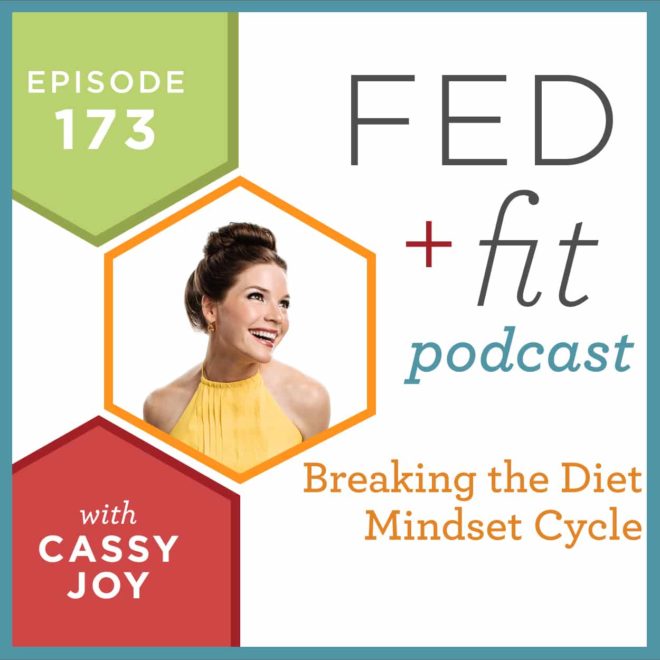
We’re back with our 173rd episode of the Fed+Fit Podcast! Remember to check back every Monday for a new episode and be sure to subscribe on iTunes!
Find us HERE on iTunes and be sure to “subscribe.”
[powerpress]
Episode 173 Sponsors
- Lorissa’s Kitchen – for 20% off on Amazon, click HERE and use code “20OFFLK”
Episode 173 Transcription
Cassy Joy: Welcome back to another episode of the Fed and Fit podcast. I am your host, Cassy Joy Garcia. And I am coming back this week with a reverse interview. I’m getting even more excited about these, because y’all have been writing in, messaging in, all of the ways, smoke signals {laughs} to relay information, virtual, that you are loving reverse interviews. And I’m really glad, because I really, really enjoy them.
So, today we are chatting with Christine! And Christine comes to us from good old McKinney, Texas. And she works there for a nonprofit. Welcome to the show, Christine!
Christine: Thank you so much for having me.
Cassy Joy: Yeah, thanks for taking the time to come on, chat for a little bit. I think you’re on your lunch break right now, so thanks for carving out a little time for us. I would love it if you would share a little bit about yourself, and also what you wanted to chat about today.
Christine: OK. So like you mentioned, I live in McKinney, Texas. I was born and raised in the Dallas area. So I never really left it. And I work for a nonprofit. I emailed you because I’ve been on my fitness weight loss journey for a really long time now. I’m 23, and I recently got married in January. And was always a very heavy child. My heaviest ever was 205 pounds, when I was going into my freshman year of high school. And at that point, I kind of realized I didn’t always want to be the overweight kid in high school, and what not.
So I started going to a gym down the street that my high school had done a joint thing with, where it could be an off-campus PE. So I had a personal trainer for a couple of years. And that really helped a lot. I had a trainer who said he was going to make a runner out of me, and I ran a 10K just this past year. So, the joke was on me in that one.
But yes. Since then, I’ve kind of been trying to find things that work well for me. I’ve done a lot of different things that I’ve seen online. From the Bikini Body Guide by Kayla Itsines. And the Tone it Up stuff. And right now, I’ve done calorie-counting, I’ve done macro counting, I’ve done Whole30. I’ve done a little bit of everything. And I have things I like, and I have noticed where I feel like I saw significant progress, but now recently I’ve realized that I think I was actually undereating significantly. So I lost my period, and stuff.
So I’m trying to find that place where my healthiest me plan, I guess. And I have your book, and I love it so far. And the journaling has been great. So my biggest thing is; I’ve found that I’ll be really focused for like 3 months, and I’ll see really good progress, and I’ll get really excited. And this happened last summer. I came home from Washington D.C. for my birthday, and I had more of an indulgent weekend. And after that it’s like everything broke. I couldn’t focus anymore. And I started snacking more. And so it’s just been like; I go through these cycles. And I’m really ready to kind of break that whole cycle issue that I have.
I have learned what kind of triggers my issues. I’ve found that I definitely snack when I’m bored, or even emotional eating. And I think I have a little bit of body dysphoria, to an extent. So just kind of dealing with all those things. It’s like; I get so frustrated at myself, because I was doing so well, and then I self-sabotaged. So it’s just a really hard thing to keep going through.
Cassy Joy: Mm-hmm. I’m nodding my head. And I have a feeling there are lots of other listeners nodding like; yes, yes! Me too! {laughs} Oh, goodness. I have so, so been there. Over and over again. And I know I really do get and identify a lot with that. Especially when you feel like you’ve hit a stride, and all things are system go, and you’re like; this is it. I’ve found the way I’m going to do life. {laughs} And then a box of Oreos are staring you down, and you have a couple. And all of a sudden you’re like; I ate two. Might as well eat the rest of them.
I’m speaking from experience. So I absolutely get that. You know, I think there’s a couple of things we can chat about. I think that, just like; you have a copy of the book. And you know definitely the Fed and Fit stance on diets is there is no one size fits all. And I almost argue to that same tune that there’s no one size fits all mindset trick, right? That’s going to help you really figure out your good set of habits.
So, I kind of want to chat about a couple of them. And throw them out there. And we’ll just see what sticks. See what stays on the wall; thinking of the spaghetti metaphor. Throw it against the wall and see what sticks.
So the first thing that comes to mind; and I’m just going to address it, because it’s the easiest one. Because I have a whole book that supports it. Easiest to address as in, there’s lots of resources if folks want to learn more about it. But one way to, I think, really help break the diet cycle. And this is the philosophy behind the Fed and Fit Project. And if you’re listening, and you’re like; how do I get into the Fed and Fit Project; currently under construction. TBD. We’re going through a whole thing behind the scenes over here.
But the thought behind it; and you can get all the information on it in the book. The thought behind it is to allow you to essentially write your own path. Because I think that what happens is when we find a diet that makes sense on the surface level, we’re not completely bought into it. Because it’s somebody else’s. And I think we know that deep down. Right? We know that because it’s a prepacked diet or protocol, we enter into it, maybe with the best of intentions, but we’re 80% of the way in the pool. We’re reserving that last 20% to where we can prove to ourselves that this isn’t the right fit. Because that’s what we hear over and over again. I jumped into a diet; I did it for three months, and then something happened and I got out. And then I did it again. Something happened and I got out. Something happened and I got out.
I think if we peel away the layers of what that means; I think what happens is we realized that wasn’t the one for us. And I think that as long as somebody else is writing it, we’re going to have a hard time really believing this protocol that tells us how we should be eating and living and exercising, we’re going to have a really hard time believing that as our own personal lifestyle gospel. Right? So I think if we’re consuming someone else’s diet, I think we’re flawed from the beginning. Because it’s not ours. It’s not yours. You didn’t write it. You don’t own it. Like you would your own.
And I say that because I spent years as a yoyo dieter. And went through a lot of that. And I had to learn this lesson the really hard way. So I think the thought behind the Fed and Fit Project was; let folks feel good. Get to a point where they feel really good, and we call that the feel-good reset, which looks a lot like a diet. {laughs} But help folks feel well, so they feel their best, and then give them to tools in a guide, a compass. Essentially put a food compass in your hand, and a pen and paper, and you start jotting down what works for you.
And at the end of that journey, what you’re left with is your own guide. It’s custom fit. You wrote it. It answers some of your deepest questions. Some of your biggest questions, if you’re like; what is this mystery? Some days I have so much energy during a workout and some days I don’t. And it kind of helps you solve some of those mysteries for yourself. Instead of thinking; this diet doesn’t get me. You get to design your own. And it doesn’t feel like a diet anymore. Because you’re also including foods that you love. You’re trying to be as unrestrictive as possible.
So I would say one way; like I said; the first one I wanted to address of really breaking that cycle is by taking the control and putting it into your own lap. Of deciding what’s right for you. Now that can feel very overwhelming; because you’re like, how do I know? How do I know what foods are right for me? There’s a whole process. And like I said, I’ve got that in the Fed and Fit book. It’s on Amazon prime. It’s in Barnes and Noble. You can go find it there. Christine’s got a copy; she might loan you one if you’re in McKinney, Texas.
So that would be a place to start if you’re really wanting to get in there. Really put in the work and the effort. And as far as; how do I actually get traction? How do I actually make this thing happen? We have a whole format outlined for you. And the thought behind it is just that. It gives you the ability to write your own rules. And I think that’s critical when we are really trying to find something that we can trust. I think it has to be authored by us.
Because that’s how I broke my own cycle. I said; forget you guys. You guys, being the world of diets. Because I was so tired of all the latest ones that I had tried that had failed me. I was very victimized by them at first. And I said I was so tired of being a victim, and I was going to take the onus of control myself. I was going to own that, and then I was going to write my own rules. And I wrote my own rules. And a lot of them I have modified, because they weren’t exactly right. But I bought into my own program more than I would have bought into somebody else’s. And that’s ultimately what mattered most. Because at that point, I wasn’t writing myself a diet. I was writing myself a lifestyle. So that’s what it took for me to get over that. So that’s what you’ll find in the Project.
So that’s one thing I want to talk about. The second thing I kind of want to talk about is this thought; not quite an overhaul. Let’s flip this whole thing on its head. Let’s scale it back a little bit and just talk a little bit around mindset around health and wellness and lifestyle.
So I think there are a couple of things we need to address. The first thing is addictions. And I’m talking real deal; physical; I need this sugar hit at 3 p.m. kind of addiction. Those kinds of things. Or caffeine. Those kinds of addictions that we have. Where we’re dependent; or we feel like our body chemistry is telling us; I need a diet coke right now or I’m going to turn into a monster. You know, that kind of a chemical/physical addiction. I think that’s the first one to address. And that’s why the feel-good reset precedes that DIY lifestyle piece in the project.
Because I think if we are able to gracefully walk ourselves through a period of essentially detoxing from somewhat addictive foods. Refined sugars, and refined flours. And; oh goodness. Heavily salted; I’m thinking Chinese takeout kinds of foods. Or diet sodas. If we can overcome kind of some of those physical things that have us being compelled towards those foods, by eliminating them for three to four weeks, I think it puts us in a much different headspace than if we were still addicted to those. And a lot of the protocols you talked about already, I know, walk you through those things already. So you’ve been through that, I’m sure, a bunch of times. As have a bunch of folks who are listening.
But I wanted to address that. Because that has to be a piece of it. Because you can’t reengineer a habit without also recognizing the physical, how physically compelled you are to proceed with an action. It’s like, saying to somebody who smokes cigarettes; just stop smoking cigarettes. Without acknowledging the nicotine addiction. Does that make sense? It’s a bigger thing than that.
And that’s why I’m an advocate for some sort of a reset. Even if that means you take one food out at a time. Because if taking diet sweeteners out, refined sugars, refined flours, heavily salted takeout foods. If that just makes you feel like; oh, here we go. We’re dieting again. If that makes you feel that way, then do one at a time. There’s no reason why you can’t do one at a time.
So, know yourself well and know what kind of a headspace does eliminating things put me in? And if eliminating a lot of things puts you into diet mode; meaning, I’m 80% of the way in, I’m going to question this 20%. Even though I don’t necessarily acknowledge that out loud. If it puts you in that kind of a headspace, then eliminate more slowly. And know that you’re doing this for the long run.
So I think that has to be addressed. Definitely acknowledging those kinds of food addictions that are out there.
Cassy Joy: Today’s show is brought to you buy Lorissa’s Kitchen! Lorissa’s Kitchen Protein snacks are made with only the highest quality meats, including 100% grass-fed beef. There are no preservatives. No added growth hormones. No MSG. And no nitrates. Lorissa’s Kitchen meat snacks come in a variety of flavors. My personal favorites are the Korean Barbecue Beef and the Ginger Teriyaki Chicken! They’re so tasty.
I always keep a few in my purse and gym bag for a healthy protein-filled snack when I’m on the go and I don’t want to sacrifice quality ingredients. Lorissa’s Kitchen Products are available nationwide at leading retailers such as Target, Walgreens, Kroger, Publix, convenience stores, as well as on Amazon.com. Use the code 20OFFLK to receive 20% off on Amazon. This is such a good deal. Again, that’s 20OFFLK to receive 20% off on Amazon.
Cassy Joy: Number two; I think that; gosh. How do I put this? Really just talking about habits and behavior in general. I very much identify with what you said about food boredom. When I am bored, or stressed. When I was getting ready for my wedding three years ago, I remember thinking; because my seamstress said; well, you want to come back in about 2 weeks before the wedding so we can do one last fitting. Because you’ll probably have gone down a size. I was like; oh, no ma’am. {laughing} Not me, I’m not that kind of bride. If anything you should leave a little room right now.
So I really get that. When I’m bored and when I’m stressed, I turn to food. And it’s one of those things when it’s worse when I’m also currently addicted to some of those foods. But it’s one of those kind of semi hard-wirings that I have to be very proactive at overcoming. And there are some great resources out there. What it is, The Power of a Habit, I believe is one of the books out there that’s great. But just learning more about how habits are formed and how we form them and how we can restructure them I think is really powerful.
And I think that if you find yourself; this is an extreme example, but it’s an example. I’m just going to throw it out there. Because it’s the only one coming into my head right now. When I was with the baby at home; which brought up a lot of my old, kind of what I thought were dormant, maybe gone issues with food. With Grayson at home with me, if I got stressed or I was tired. And you know, when you’re tired, that was a trigger for me. Also being tired. I was tired, maybe a little stressed. Maybe a little bored. Maybe a mix of all of the above. And I would turn to; what kind of crackers, or cookies, or gluten free pretzels are in my pantry right now. And I would eat a handful of those. Because I thought that’s just kind of what I needed. I needed something to do.
And I got to a point of an example of replacement behavior for that was I did two things. As soon as I felt myself walking to the pantry for some sort of a carbalicious treat. Which; nursing mamas need. But I needed a baked potato, not a cup of pretzels. I was not hungry. I knew I didn’t need the nutrients. I was just going to snack mindlessly. So instead I would reroute. I would go to the refrigerator; and I’m sure you’ve been through these, too. I would grab a glass of water, and I would drink a whole glass of water. And if I still wanted the treat, then I would 20 air squats holding the baby. {laughs} Sometimes holding the baby. Because she didn’t want to be put down.
And if I still wanted them after my water and after the air squats, then I’d have them. But 90% of the time, I didn’t. 90% of the time I just needed a little bit; because we get this rush. This adrenaline rush when we feel like we’re getting away with something. Or we’re cheating. That’s why I hate that cheat word when it comes to diets and lifestyles. Cheating gives you this rush when you feel like you’re doing this thing, and it becomes a hardwired habit. You feel like in order to get this rush, I need to go cheat and sneak and eat the Oreo.
So if you can give yourself kind of some other feel good hormones at that same time, doing the air squats. Get a little pump of; oh my gosh. Endorphins! {laughs} I was like; what is it in Legally Blonde? {laughing} To reference Legally Blonde she says; “She exercises, and exercise gives you endorphins. Endorphins make you happy. Happy people just don’t kill their husbands.” {laughs} That’s it.
Anyways. It gives you a different kind of rush that then replaces the other one. And eventually, I got to the point where I did the water and the squats. Which are both really good for me. And I really needed to do those anyway. That’s a really good functional movement that I want to be practicing right now post baby. And I was also able to; then, all of a sudden, I went enough days and I got over this habit/addiction to the pretzels in my pantry. And it became easier and easier to avoid them. And I started doing less and less squats. {laughs}
But that’s kind of another thing to think about. How do I hard rewire these habits? How do I find a way to replace them? Because just telling myself; no. Today. Today I’m not going to eat the pretzels. Today I’m going to sit in this chair and snuggle my baby. And I’m just not going to want them. I tell myself I don’t want them. And that’s just not going to work for me. I needed to replace the actual habit. I needed to do something. So if you find yourself being triggered by boredom, replace it with something.
Maybe it’s getting up, and grabbing a tea bag, and heating up some water. And making yourself a cup of herbal tea. And squeezing a lemon in it. Something that requires a pretty mechanical, physical action. Do something like that. The air squats and the water; I knew I wanted to do more squats and I knew I needed to be drinking more water. So that was a good sub for me. So I would add in a healthy habit. So that’s another one to address with the habit.
And the other thing is there’s no way you’ve made it this far, and had so much incredible success, Christine, that you don’t also know a lot of the reasons why. It sounds like you’re a very well-informed person. But I would say that another missing link. The third one I want to quickly chat about. I think a lot of folks underestimate the value of knowing why something is important.
So it’s kind of like; let’s say you have the habit of going to Starbucks and ordering yourself a large soy latte. And you just like it. That’s just your favorite drink. It’s your jam. It’s your go-to. But somebody told you that soy may not be the best choice. And you don’t really know why. So you’re trying to avoid soy lattes. This is a pretty skin-deep example, but I’m sticking with it. {laughs}
Your likelihood of continuing to avoid the soy latte and maybe replace it with a giant tea or a black coffee or something like that, your ability to or your inclination to keep choosing the healthier option is pretty unlikely if you don’t know why soy may not be the right choice. May not be the healthiest choice.
It’s like; in order to get over some of those habits, and some of those physical addictions, or just that compelling nature that certain foods have over us in a slightly; I don’t want to overuse the word, addictive way. But in a way that we’re constantly compelled to go back to them. To really get over either the physical aspect of it or just the habitual aspect of it, we really need to arm ourselves with as much as possible, and knowing why is really important. Soy can be an estrogen mimicker. And if we have estrogen mimicking hormones floating around in our body, it can do a lot of things to both men and women. Hormones are just like a house of cards in a lot of ways. Not necessarily that fragile, but one thing definitely affects everything else.
More like a spider’s web, is a good way to put it. If you pull on one thread, the rest of them are moved. So somebody who is maybe trying to really get on top of some sort of hormonal thing that they know they’re tracking, that would be the motivator to avoid soy. So I think knowledge is really powerful in these kinds of circumstances. Because if you didn’t know and you just thought; well, it’s a healthier option. You’ll probably be less likely to continue to avoid it or to say no.
So the three things are; I think, figure out a way that you can DIY your own “program.” That’s the one that takes the most work. That takes the most effort. You’re going to journal till you feel like you can’t journal anymore. And you just keep writing down observations. You keep writing down personal insights. You keep writing down the things that make you feel great. You write down the things that make you feel crummy. And you keep taking those notes; over and over and over again. And then, at the end of the week, you reread your notes.
And the things that pop out to you; wow. On the days that I felt great during my workout, I also had a potato. Or some sort of a starchy vegetables at dinner the night before. Then all of a sudden, that can become one of your own personal rules. If you’re like; yep. I really want to crush it in tomorrow’s workout, so I’m going to go ahead and scoop me up a serving of pureed butternut squash.
So that takes the most effort, but I think that’s the most lasting way to really break this mindset cycle of yoyoing back and forth. Because you’re not dieting anymore; you’re going on the offense. I would say the second way would be to figure out in the short term how do we rewire our habits. How do we replace them with healthier options? And it’s by acknowledging that we actually do have to replace it. If I’m going to take something out of your hand, we need to put something else into it that will replace and has the same weight and feel.
And then three; learn as much as you can. If you’re really struggling with sticking with something, then start digging into the research. Start Googling. Remind me again why I don’t want to be doing X. And dig into the research. Arm yourself with as much knowledge as possible, so that when you start to question it, or you feel like you’re less likely to follow through on an intention that you set. Or your will feels a little bit weakened. You at least have this huge knowledge base to fall back on to remind you why.
Was that helpful, Christine?
Christine: Oh, yeah. That’s completely helpful.
Cassy Joy: Good.
Christine: A way to have something to focus on, rather than, why isn’t this working.
Cassy Joy: Yeah, exactly. It’s such a helpless feeling to feel that way. And like I said, I know it. I’ve lived that so many times. And those are the things that really helped me. When I really turned my diet/lifestyle around. Meaning, I just rewrote the script of how I dieted and how I lived. How I really did that was the first thing I said. I started taking notes, and I did the things that worked for me. And I started to ignore external; you need to eat one piece of whole wheat toast with a schmear of whatever on it for breakfast if you want to be healthy. I started to ignore some of those things, and I just did what worked for me.
And then two and three; the knowledge has really helped me. Learning as much as I can about the nutrition science. And then replacing habits with healthy ones. Because it’s always going to be a part of that. And to deny that certain foods are compelling I think is a little bit of a fool’s errand. And we really need to be proactive. And I think tackle some of this stuff so that we’re really setting ourselves up for success.
Awesome! I just chatted at you. {laughs} For 20 minutes. I hope that was ok.
Christine: Oh, you’re totally good. I enjoy it.
Cassy Joy: Good. Awesome. Did that bring up any questions, before we go?
Christine: No. I think you covered everything pretty well.
Cassy Joy: You’re like; nope. You talked about it all and then some! That’s great.
Christine: Well now I have a game plan.
Cassy Joy: Good. That was the goal. That’s really exciting. I’m really excited for you. Please keep me posted. Don’t be a stranger. And I would love to stay in touch.
And for everybody listening, I hope today’s call/podcast was helpful. And if y’all have any questions, head over to the blog, www.FedandFit.com, and the show notes. And you can leave a question there. We’d love to chat some more about this. You can find a full transcript there on the show as well. And as always, we’ll be back again next week.