On today’s episode, I invite Fed & Fit listener Bailey to come on the show for Reverse Interview! Bailey and I talk about the pro’s/con’s of calorie counting and how to know if you’re eating enough.
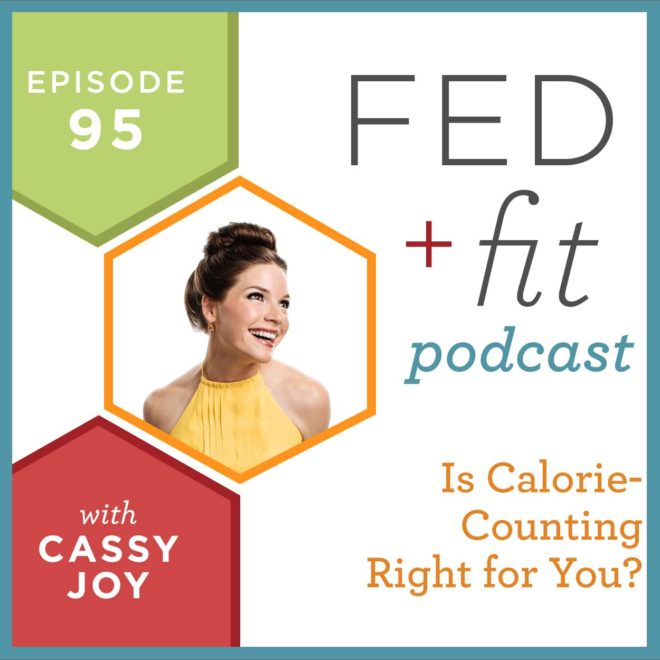
We’re back with our 95th episode of the Fed+Fit Podcast! Remember to check back every Monday for a new episode and be sure to subscribe on iTunes!
Find us HERE on iTunes and be sure to “subscribe.”
[powerpress]
Episode 95 Sponsor
- Today’s show is proudly sponsored by Aaptiv! Be sure to enter the promo code ‘fedandfit” (one word) at checkout, and your first 30 days are on the house.
Episode 95 Transcription
Today’s show is brought to you by Aaptiv! Aaptiv is a fabulous app and robust online community that allows you access to top notch, motivating personal trainers who guide you through an audio-based workout that is timed to your choosing with fun, perfectly synchronized music. I like to think of it like Netflix for fitness. Aaptiv gives members unlimited access to their entire bank of high-end, trainer-led workout classes. If you’re looking for fresh, high quality, on the go, motivating workouts that adapt to your lifestyle, I highly recommend Aaptiv.
In fact; if you head over to the curator playlist section of Aaptiv, you’ll see a familiar face! I chose 7 of my favorite Aaptiv workouts that you can kind of get a sneak peek into my own routine. Everything from well-rounded mix of intense cardio to restorative serenity; I hope you enjoy it. And then because they’re just the best, Aaptiv is even offering Fed and Fit listeners a free 30-day trial. When you sign up for a monthly subscription at www.Aaptiv.com; be sure to enter the promo code FEDANDFIT, one word, at checkout, and your first 30 days are on the house.
Cassy Joy: Good morning! We’re back with another episode of the Fed and Fit podcast. My name is Cassy Joy Garcia; I am your host. I am the owner, and the author, and the founder of https://fedandfit.com; the author of Fed and Fit the book, which is available in stores nationwide. You can find them in Barnes and Noble, and currently in Costco. And I like to give these brief introductions now, because we are having newer and wonderful faces show up here at the podcast who are finding us organically through iTunes. And they’re finding us because current listeners are leaving reviews in iTunes; so thank you so much for doing that, and welcome to all of the new faces; or I guess I should say new ears. {laughs} I’m excited to have you. What we like to talk about is health and wellness from a 50,000 foot view sometimes, but every once in a while we like to zero in, answer some very direct questions. And today’s episode really speaks to that part of the show.
I like to do occasionally, sometimes I get on a roll and I do a whole bunch of them {laughs} I like to do what I call listener reverse interviews. And this is where a listener of the Fed and Fit podcast, or a reader of my blog or book, writes in with a question. And I get a lot of questions via emails, and I like to respond to all of them. But every once in a while, I get a really good question, and my response back to these sweet people is; this is a great question; how about I record the answer I give you over Skype. {laughs} And they graciously accept, and so today’s is that. And the reason I want to record the answer over a phone is I think that these questions are some that more people have. There’s more than just the young lady we’re talking with today; her name is Bailey. It’s probably more than Bailey out there that’s wondering some of these things. So I wanted everybody to be able to benefit from this type of conversation. So that’s the point of these reverse interviews; it’s really one of my favorite parts of this podcast, and I hope you’re enjoying them as well.
So, let’s talk today; I’m going to briefly introduce how these reverse interviews work. As I will briefly introduce today’s guest interviewer, and then I will hand the baton, or the virtual mic on over to her, and then she’s got the reigns for the show. She can ask me whatever questions she wants, and then we’re just going to chat for the next 20 to 30 minutes. So that’s how it works. Ok, so today I’m joined by the lovely smart and funny Bailey. She is in Indianapolis, Indiana, and she is an attorney, and I’m so excited to be talking with you today, Bailey; welcome to the show!
Bailey: Thank you so much, Cassy! Hello Fed and Fit listeners. I am so delighted to be here. I listen to the podcast every week, and so thank you for taking the time to not only listen to Cassy’s podcast, because I think it’s fabulous, but taking the time to let me take the reigns over this show and ask Cassy some questions.
Cassy Joy: Oh, you’re the best!
Bailey: Aww, you’re the best!
Cassy Joy: {laughs}
Bailey: {laughs} The question that I emailed Cassy about just to give everyone a little bit of background was about calories. Which, seems like a pretty simple concept; everyone knows what a calorie is. But when I initially got into paleo living and the paleo lifestyle, there was such a focus off of calories. Which I really loved; it’s all about portion sizes, thinking about the foods that fuel your body, Cassy’s Fed and Fit book talks a lot to this and gives so much great information to the proper portion sizes; how to create a meal, what different components should go into that. So I’ve really enjoyed that mindset. But then there was one day I got curious about how many calories I was eating. So I got to the end of the day, felt satisfied; had had three meals, a healthy balance of proteins, fats, and carbs. And I was only between 1100 and 1300 calories; so I started to wonder, is that actually enough to fuel my body?
So the question that I want to turn the mic back over to Cassy to answer is, how much focus should we be putting on calories, and what’s a good way for us to know if we’re properly fueling our body?
Cassy Joy: Great question. Man! I didn’t remember exactly; I like to be surprised by these reverse interview questions.
Bailey: {laughs}
Cassy Joy: So I try to not refresh myself because I want a more organic answer, and that is just such a good question Bailey! {laughs}
Bailey: Well, thank you.
Cassy Joy: Thank you! Ok, so. Gosh, and this is definitely resonating with a bunch of folks out there. Ok, so I would say that, I’m going to answer all around your question first just so we can kind of understand the landscape really quickly.
Bailey: Sure.
Cassy Joy: So I think that tracking calories can be a really powerful tool if you have a very specific goal, ok? For general health and wellness it could actually be an obstacle. But if you have a very specific goal. Because I want to talk first to the pros; I don’t want to bash calorie counting at the get go or out the gate, because there are some pros. What are some of those pros?
If you just; let’s see. If you have physical fitness goals, for example, or you’re looking to gain a lot of muscle mass. I’m thinking of a lot of men that I’ve worked with in the past. They want to gain muscle, they want to not gain body fat, and they want to be able to lift heavier things in the gym. You know, that sounds familiar. They want to put on 20 pounds, but they really just want to up their muscle body composition. In that way, it can be beneficial to track calories from the viewpoint of, they’re actually consuming way more food at that point, so they’re going to look at macronutrients, right? They’re going to be consuming more protein, more fat, and then just keeping an eye; a lot of carbs, so it’s not low-carb by any means. But they’re going to be increasing the other two. And then it’s helpful to look at those buckets; those protein, fat, and carb, not only by gram but also by calories if they’re trying to get things figured out at the beginning. So that’s a really powerful tool and it’s really effective if somebody is trying; if they’re truly looking at food as fuel, for those specific goals.
Now, for general health and wellness; people who want to feel better. Maybe we want to have a little bit more energy; and I’m kind of imposing this over you, Bailey, so please correct me if I’m wrong.
Bailey: Impose away.
Cassy Joy: Impose away; ok good. I’m thinking of myself, for example. I want to feel good, I want to have energy throughout the day; I want to be able to perform in my workouts. If I am healing myself like I was about 9 years ago, when I first introduced this anti-inflammatory protocol; I wanted my clothes to fit a little bit better back then, then I think calorie counting can actually obscure what foods would benefit us, right? And the types of foods and the amounts of foods. Because really, mostly because I’m trying to break that dependency on a diet mindset, right, that we need to count and track all the things that are showing up on our plate versus just being an intuitive eater, listening to our bodies. I think it was Liz Wolfe who said moons and moons ago; {laughs} many moons again, she said, “I just think of myself as a nutrient seeker.” And, I thought that was so clever, because at the end of the day, that’s what I think general health and wellness sets us up to be. We’re set up to be nutrient seekers who are just listening to our bodies and trying to give it what it’s asking for.
So those are kind of the way I see it for the most part; two very generic camps, right? When we’re being more scientific and tracking more strategic about the food that shows up on our plates for very specific goals. Now, building muscle mass isn’t the only possibility out there, but that’s just a really common example. Or if we’re just seeking general health and wellness. So those are the two camps that I like to speak to.
I believe that a way to know if you’re eating; so if you’re trying to seek general health and wellness, do I recommend tracking calories? Generally no, I don’t. Because I do think that it can obscure what the ultimate goal is, and that is to become an intuitive eater. Right? Because if we’re tracking numbers and we’re basing our next meals decisions on the numbers that we wrote down from yesterday, it’s purely from a numbers standpoint or a strategic analytic standpoint, it might cloud our view or our vision or our perception of what our body’s actually telling us. So it kind of sounds a little foo-foo until we get into it.
But the way that we do that is by journaling. And that’s why I do recommend within the Fed and Fit Project and beyond that writing down; keeping a food journal, I want to clarify. When I say a food journal, I’m not just imagining, “For breakfast I had 3 eggs and 27 raspberries.” You know, it’s not that I want us to keep track of exact food quantities; even going down to the calorie, of course, would be the next step from there. But I want us to track qualitatively, how are we feeling? So the eggs and the raspberries, and let’s say we threw in a breakfast potato with it. “I felt great, I was a little hungry towards; I don’t know, around 10:30 a.m. I got a little hungry and therefore I think in hindsight if I up a little bit of fat content on my plate, because my carbohydrates and my proteins look pretty good, just from a bird’s eye view, then I think if I up my fat content, it might get me all the way to lunch.” And you try that the next morning, and it gets you all the way to lunch, and you feel great; your energy levels are great. You’re not rolling into lunch hungry, or hangry and ready to just sink your teeth into a great big meal, and more likely to make a decision that’s not in line with your personal scope.
So I prefer to track foods; and I promise I’m going to answer your question directly eventually {laughs}.
Bailey: You always circle around and then come back in, so I was totally expecting us to go all around it first.
Cassy Joy: {laughing} Oh you do know me.
Bailey: {laughs}
Cassy Joy: So I think that it’s important to track our foods qualitatively, and that’s how we’re really going to make personal breakthroughs. Because we might find; because everybody is different. Every body is going to be totally different in what you need; what you need and what I need to get to lunch and to dinner and to have energy and to be feeling our best and to be sleeping really well and to not be hungry is all going to look different for each person. So writing down how we feel after meals; how we feel the next day, and then making tweaks based on how we feel is where I like to lean. It’s where my bias, my business is pointed towards.
Now. Every once in a while, I’m with you. Every once in a while, I will track my calories, because I’m curious. {laughs} Because somebody asks me, “How many calories do you eat in a day,” and I can’t give them an answer because I have no earthly clue. And every once in a while I’ll track it, and sometimes it fluctuates greatly, depending on the season and depending on the types of foods that I’m eating and how I’m preparing it. Because we all get into trends and grooves. If I’m making a lot of fried fish; it’s not deep fried, but I’m cooking it in fat, that absorbs a lot more fat and calories than other types of meat preparations, you know, so it will go up. So every once in a while, I’ll calculate it, and sometimes in the upwards of near 2000-plus in a day, and sometimes it’s down in the 1300s, right there where you found yourself.
Truth be told, I would say that if I look at how many calories I’m consuming in a day, it probably fluctuates a good amount because I’m just; again, I’m being a nutrient seeker, and my meals look a little bit differently every day, because I really place a huge emphasis on changing my plate, right, as much as possible, because I’m trying to get in as many different kinds of foods and vegetables and fruits and proteins and fats as possible. Because that’s really the best way to chew your multivitamin so to speak.
So I kind of tried to look at calorie consumption across the span of an entire week. I think it’s going to be a little bit more of an accurate representation. And if over a week, if I really have been under eating, I will feel hungry and I will feel tired. The numbers will reflect that. And that will change based on if I’m working out really hard; right? I will need more food, I will need more starch, I will need more proteins and fat at certain times of the day. But my body would have told me that before I really felt kind of crummy or run down.
So, the very, very long {laughs} story summarized is; I think, Bailey, that if you feel fine, you’re not feeling tired; and I’ll ask you that question in a second, but depending on how you’re feeling. If you’re feeling find and you’re not feeling run down, and if you are working out right now, you have energy to get through your workouts; you’re eating enough. And you’re eating enough of the right stuff that your body has found a groove, and metabolically everything is clicking into place. It might look like not enough calories, but there’s a chance that sometimes your body just doesn’t need that many calories. Seasonally women, especially who are of childbearing years, when we get to that part of the month, the luteal phase of our cycle right before menstruation, we eat more. We need more calories, right; so you could even look at calorie consumption not even on a day, a week, but on a month span. You know, it’s going to fluctuate as time goes on. The macronutrients that we consume are going to fluctuate. So zeroing in on a day; it’s hard to say what your target number should be if you did want to track them. But that’s why I always try to lean on, “how are you feeling?”And that will give you the most accurate answer. Is that helpful?
Bailey: That is so helpful. And I think it’s perfect how you separate it out into; do you have very specific fitness goals that you’re wanting to meet in terms of your muscle mass or your body fat percentage or you’re a performance athlete; or, are you just seeking general health and wellness, or pull a Liz Wolfe; are we nutrient seeking? And those two camps can look to tally different in how you need to approach your nutrition. And you spoke to something talking about macronutrient buckets; so there you’re talking carbohydrate, fat, and protein. Is there a way that you’ve found what combination of those three macronutrients works best for you? Did you find that through your food journaling, like you talked about? Or do you just constantly reevaluate that just based on your life, just like you were talking about.
Cassy Joy: Mm-hmm. Great question. So I did; I went about it kind of the reverse way, because I don’t have those very specific goals. Now I have mentored different people on coming up with specific grams that maybe they should be consuming, and the ratios, but me personally I’ve never calculated that for myself because I don’t have those specific goals. Instead, I know, again, 30,000 foot view. What do I want my days’ collective plate to look like? I know that I want at least two servings of some sort of a starchy vegetable; or because white rice works for me, that will count. Very occasionally I will have some sort of a gluten free grain, like a pasta or something like that. That would count in there. So at least two servings of a starchy vegetable; three if I’m in my luteal phase, or three if I’m working out really, really, really hard. So those are all considerations to be taken into; {laughs} those are all considerations to be taken into consideration.
Bailey: {laughs}
Cassy Joy: Writing a book was really fun. The editors had a blast with me. {laughing}
Bailey: You don’t realize all the interesting verbal tics or just writing tics that you have until you write a whole lot of material and then read back through.
Cassy Joy: It’s so true.
Bailey: And then you realize that you used certain phrases all the time.
Cassy Joy: It’s so true. And I use a lot of phrases, they caught me on a bunch of them. Just modern phrases; like, oh gosh, this pasta is life. They’d be like; you cannot write that in a book. {laughs} You cannot put that in a book, because it will date it. They’ll say, this book came out in 2016. Ok, sorry I digress. {laughs}
I would say, so looking at the days’ plate from a 30,000 foot view. So I have two to three servings of starch, I have 3 solid serving of vegetable; nonstarchy vegetable right, so those are the leafy greens, the peppers, the leeks, just thinking about what I ate yesterday.
Bailey: Those leeks looked delicious, by the way; I saw those on Instagram.
Cassy Joy: Oh they were so good. You know, I’m constantly curious about; again, I’m a micronutrient seeker, also, and I’m constantly curious about what vegetables out there that hold some sort of mystical, wonderful nutrient that I’m not getting anywhere else in my diet. And leeks popped up on my radar, and I was like; let’s go buy leeks, and let’s just eat a heck of a lot of them! {laughs} So I did, and they were good. I cooked them kind of like spinach; just a lot of lemon juice and a little butter and some salt. They were really good.
And then of course I have protein, 3 servings of protein on that plate as well. And the way that I know, looking at those macronutrient buckets how I need to adjust. Now I’ve been doing this for a long time, so I know probably at this point what needs to show up on my plate in order for me to feel really good. If I don’t have any sort of a starchy vegetable at breakfast, I know that I need to plan on one at lunch. Or if I don’t have one for lunch and I have one for breakfast, I’m definitely planning on one for dinner. So I just make sure that my overall day kind of equals out. So that’s really how I approach it.
And it’s more of a; it’s kind of, just think about growing up, your mom says, “you need to eat your greens” or “you need a serving of this” or “you need a serving of that.” That’s kind of how I approach macronutrients; I need to make sure I get a serving of this or a serving of that. It’s not necessarily; “Do I need half a cup, or three-quarters of a cup of white rice?” You know; what’s the right amount for me to take in, because what I’ve learned over time is I want to have that more relaxed relationship with food. My personal goal is to be able to sit down, serve myself up intuitively a scoop of rice, you know, and not fret over if it’s too much or too little, because at the end of the day, it’s all going to be fine. It’s all going to equal out at the end of a week based on my workouts, or how much I eat the next day. If I ate too much one day, I’m not going to be as hungry the next day, so I’ll just take a slightly smaller scoop. Does that help answer that question?
Bailey: That does help. One thing I’m really taking away from this is kind of piggybacking of what you just said is; if you eat too much one day you’re not going to feel as intuitively hungry the next day, and that goes back to how you were speaking of thinking of calorie consumption on a weekly basis. Because putting yourself into day by day brackets could cause you to eat more if you have a certain calorie goal that you’re wanting to hit or think that you may need to be within when your body isn’t really hungry for those foods. Whereas another day, you might eat too few calories, because you’re trying to stay within a certain number, when your body is actually telling you that you need more fuel. So I like that concept of thinking of it on a more overarching flowing basis rather than just every 24-hour period exactly what am I doing.
Cassy Joy: You nailed it, Bailey. That’s perfect. You said it better than I said it. {laughs}
Bailey: Just learning from the master, Cassy.
Cassy Joy: {laughing}
Bailey: So tell me; you mentioned that you have a lot of new listeners, so for people that are listening that may be new to this way or eating or are just beginning on their health journey to try to find what foods make them feel good; obviously the adjustment period for them may be a little more intense. You said, if you’re not getting enough carbohydrate or if you’re getting too much carbohydrate, it’s really easy for you to listen to those body signals and tweak them, because you have so much experience; almost 9 or 10 years now since you really went on your health journey. So how long would you recommend people that are just now starting give themselves, when they’re starting out, before they start making any significant changes? How long does it take to kind of see truly how the foods that you’re eating are making you feel? Does that make sense?
Cassy Joy: It makes perfect sense, and it’s another great question. So on the long end of the scope, and I do provide; so in the Fed and Fit book, because I wasn’t just born knowing how to eat this way. And I’m thankful that you brought that up, because sometimes I forget. Sometimes when you’re in a groove, you forget to address when you first started, right?
Bailey: Absolutely.
Cassy Joy: And that’s something that I’m constantly trying to be better about in my business. I need to be; man, I have been putting it off. I need to post a before photo, ASAP, because I haven’t posted one in over a year. Because I just don’t think about it.
So, I would say; I like to say that I was a really slow learner. I am a slow learner. It takes me a while to really pick up on things. So for me, it took me about a solid year. Now, that was a year of, this was before paleo was necessarily mainstream, and I was really resistant; I was kind of a stick in the mud about it. I was resistant to jumping into another diet, right? So I put off some of the paleo principles. I’m doing my own thing; it’s called anti-inflammatory. {laughs} And I read about it all of these articles.
So it took me a long time to really figure things out and figure out what really was working for my body. And I do still stick to that; I think of it as just eliminating the inflammatory foods, replacing it with anti-inflammatory ones, and doing things that are just generally good for our body. That’s really how I think of it. And it just happens to look almost identical to paleo.
My book has paleo on it; don’t get me wrong, I’m not knocking it. But I would say that it took me about a solid year, and I learn lessons really slowly. But what helped me the most, because I did come from; I only knew how to diet. I only knew how to choose food based on whether it was a part of my diet or not a part of my diet, right? If I was dieting, then I would order the egg white omlette on a whole wheat wrap. Right? And if I was not dieting, then I would order the extra cheesy biscuit with, I don’t know, hash browns on the side. That was how I made food decisions. Whether it was a part of my protocol or not. So I was coming from that onto a little bit more of trying to get that intuitive eating plan, and first I started with the types of foods, and then I wanted to track exactly calorie numbers, and then I decided that I needed to grow from that, so I went into sort of portion size buckets, and that is what finally helped me unlock; I worked within those portion size buckets for several months until I finally got to the point where I could take the training wheels off and I could stop thinking of a cup of raspberries as a serving of raspberries, and I just piled some raspberries on my plate. Ok?
Now, so what I did provide in the Fed and Fit book is, I call it the portion compass, and what I put there is a portion size recommendation for men and for women for, you name the food. And the reason for that is speaking exactly to the group you just pointed at, and exactly where I found myself; that was the most helpful for me, was when I was trying to stop thinking about exact calorie counts, and looking at food like we’ve talked about, more qualitatively. Here’s an approximate amount of this food that could be an appropriate amount for you to show up on your plate. Now, I call it a compass; I’m not calling it hard and fast rules. I’m not saying that a cup of raspberries is the right amount for every single person out there, but at least you can know where north is, right? And through journaling and through listening to your body, and through trying to figure out what makes you feel good; whether that’s overly full, so maybe we dial it down a little bit; or that’s it hungry so we need to dial it up. You’ll be able to kind of figure it out from there, but it’s a good starting point to give you portion sizes just at the beginning; or as long as you need it; right? For me, that was several months before, like I said, it took me a full year through this whole very resistant journey when I first started. But that’s about how long it took me. I hope that helps answer that question.
Bailey: That does. And I think for listeners that are new that may not have your book, or be too familiar with the Project, I think that’s one thing that you do so well, is you realize that there are people of complete different personality types, and there are people that, as you have said before, want to rip off the Band-Aid, jump all in, dive into the deep end without any floaties and just commit to this way of living. And then there are some people who need to wade in, and need time, and want to slowly try things out and see what works for them. And you provide both options for that.
So I would really recommend for people that aren’t familiar with the Project, buy the book. You guys, it is full of so much information, and it is great, and it’s a wonderful resource and I can’t recommend it enough. It really isn’t a one-stop shop for, this is the only way you need to do it. Cassy really lays out, “this is where we want to get you, and let me show you a couple of different ways that we can get there based on what works best for you.” And I think that is just such a refreshing way to look at it; because we’re inundated with information. You can get on Instagram, or start Googling something, and you find 17 different opinions, all about the same thing. One article will tell you you need to eat tomatoes every day because it’s the best food in the entire world; and one article will tell you that tomatoes are killing you slowly.
Cassy Joy: {laughs}
Bailey: So it’s just very hard to know what is right and what is best. So I think any program or template that allows people to kind of match themselves to a pathway, is really great, rather than saying this is the one and only way.
Cassy Joy: Bailey, you’re just the best. You want to come back next week?
Bailey: {laughs} Any time. I would love to come back any time.
Cassy Joy: {laughing}
Bailey: This is so fun. And I know we are getting near our time, so I just have a few wrap up questions for you that have absolutely nothing to do with what we’ve been talking about.
Cassy Joy: Ooh, fun.
Bailey: But you are obviously a busy woman; you are an entrepreneur, you have a blog, podcast, you write books; you do all the things. What is your favorite way to recharge?
Cassy Joy: Oh, what is my favorite way; you want to know; oh man. I’m going to give you the answer I want to give you, and I’m also going to give you the honest answer that just popped up in my brain.
Bailey: Ok.
Cassy Joy: Because I have to. I’m one of those painfully honest people; probably to my own detriment.
Bailey: Right there with you on that.
Cassy Joy: {laughs} Oh man. I would say; so the answer that I want to give you, which is still true. It’s still a true answer it’s just not the first one that came to mind; I love spending time, any sort of time outside, probably because I’m forced to be unplugged, right? Because my job is me and my computer and my desk and my microphone, and my kitchen, and my camera. And it’s all tethered to the house in order for me to be able to do my job, right? I’ve got my little mock kitchen studio here, and I’m tethered here to do this work. Not that I don’t love it; I love it. But getting out of the house feels like an actual break. I have to physically break from it. So we’re in spring now, or coming up on spring, and I’m so excited to start gardening, so that’s going to be something. I play golf with my family, so that’s another really fun thing that we do. But really getting outside, going for walks, things like that with Gus.
And then the answer that I didn’t want to give you, but it came to mind {laughs}. There is this silly, silly game on my phone that I will play sometimes. And I’m pretty sure it was made for 6-year-olds.
Bailey: You have to tell us the game.
Cassy Joy: {laughing} Oh my gosh, I’m so embarrassed.
Bailey: {laughs}
Cassy Joy: It’s something farm. It’s made by the same people who did; it’s the Candy Crush people.
Bailey: Oh. I know a lot of people that have gotten very into this game.
Cassy Joy: Do you?
Bailey: To the point that they’ve paid money to buy whatever kind of farm currency you need.
Cassy Joy: {laughs} {gasp}
Bailey: So don’t worry, I don’t think that you’re alone in this obsession.
Cassy Joy: Oh my gosh. I feel so embarrassed. Ok, truth be told I refuse to buy; I refuse to pay any money. So I will sit here and I will play a level, like for a thousand times. I’m not going to spend any money on it, period. But at the point now, Bailey. And I will play this game; it’s not like I play it all day long. It’s just; it’s like a punctuation. Right? Because every once in a while you get an email that doesn’t make you feel too great, and I need to forget. But I can’t go off; I don’t know, I can’t just go get another cup of coffee, because I’ve already had too many cups of coffee {laughs}. So I will sit there, I will play one little thingie on this game, and then I’ll move on. And that’s kind of how I just move on from certain things. And I’m to the point now where I have played this game so much that I am on their leader board. {laughs}
Bailey: {laughing}
Cassy Joy: It’s obscene. It’s obscene.
Bailey: You should start publicizing that more. I think you need to go change your Instagram bio immediately.
Cassy Joy: {laughing} I’m like; I told my husband this the other day, and he was like, let me see this thing. And on this leader board, all the people on this leader board have actual names and avatars, and for me, it’s this random picture that they associated, and like user number 4578 blah blah blah {laughs} because I refuse to register {laughing}. Anyways, those are the things that I do.
Bailey: Those are both amazing things.
Cassy Joy: I’m so embarrassed. I’m not totally embarrassed, because I knew it would eventually come out, but there you have it.
Bailey: There you have it; February 15, 2017.
Cassy Joy: {laughing}
Bailey: Let the record reflect that Cassy Joy Garcia is on the leader board of the Farm game.
Cassy Joy: {laughing}
Bailey: In your answer to that, you kind of said something that leads me into my next question. You mentioned that sometimes you get emails that make you not feel so good. And you are obviously putting yourself out into the public realm. You share a lot of your life with us, and that is a very vulnerable thing, especially for women. I think that naturally we just have some insecurities and hesitation more so than a man might, that is starting his own business. So how do you find that balance in being willing to be vulnerable and share, and not letting anyone else whether it’s their opinions or their comments dictate your self-worth or your motivation to continue putting out great content for those of us that are really loving it?
Cassy Joy: OH, that’s really sweet and a really great question also. Seriously, Bailey, you’re coming back next week if you’ve got time. {laughs}
Bailey: {laughs} I would love to.
Cassy Joy: I would say; that’s a great question, and it’s something that definitely took time. I think that when I first started out, I was definitely more susceptible to criticism, and it; you know, it’s kind of like, if there are three arrows pointed at you, and two of them are sweet and uplifting and one of them is hurtful; if it’s a third of the arrows, it hurts more. But over time, when you have hundreds, and then thousands, and tens of thousands of arrows pointed at you. I don’t know why I chose arrows, but I did. {laughing} And they’re pointed at you, and it’s now all of a sudden it’s only 3% of them, then they tend to hurt a little bit less.
And I would say that I still feel; the emails that don’t make me feel that great, or comments on Instagram sometimes, or Facebook, that don’t make me feel that great or aren’t that uplifting, I still definitely feel them. I’m still a human being; and like you said, I’m an empathetic person by nature, right, and I want to just reach out and hug. I consider my job answering your concerns. And so when somebody gives me negative feedback, a part of me sees it as my personal reasonability as a part of this job to address it. And eventually I got to the point where I realized what was my responsibility and what was not my responsibility, and what was a reflection on me as a person and what was maybe more of a reflection on them.
Bailey: Absolutely.
Cassy Joy: Who I can help and who I cannot help; and that just took time. And to be honest, the thing that helps me through that the most are the sweet, wonderful people. The people shooting really warm, lovely, uplifting arrows in my direction. There are some times where you get a string of some emails that aren’t that wonderful; or comments on social media that aren’t wonderful. And don’t get me wrong; I have a tribe. A tribe; it’s a term for business, right, but the people who consider themselves a part of this Fed and Fit family are the most wonderful people in the world. I consider myself very fortunate, because everybody is very uplifting and positive; much like yourself. Really smart, really intelligent, really positive, kind people. And I’m the luckiest girl in the world to be surrounded by so many wonderful folks. So it’s a very distinct, unique tribe; the Fed and Fit tribe is.
However; not however. I would say that because of that, you guys are my backbone for propelling me through all the tough stuff. I would love to take credit, and just say, “Well I have a heck of a lot of self confidence.” I would love to take credit for it; but at the end of the day, I have to give credit to the people who are sending nice notes. Because every once in a while, the universe just answers. I’ll have a rough day; or a bunch of recipes will fail; or something that I was hoping would do really well didn’t do really well on a product or something like that. And then I’ll get an email from somebody that just says; hey, I just wanted to let you know that I’ve been following some of your recipes, and I’ve been following you for years quietly and I never said anything, and I listen to your podcast, and I just want you to know my life is different in a wonderful way. And that just; man, it’s just those 300 words, or whatever it is. I bounce out of my seat and I’m ready to go tackle the next thing. So I would say that is how I’m motivated to share more about my life, because of the positive feedback that I get. And it’s because of the positive feedback, I’m also able to have a better understanding of when I get negative feedback, how it fits into the big picture.
Bailey: Absolutely. And I think that’s just such a good reminder for those of us that are consumers of content; regardless of whether that’s in the health and fitness realm or whatever it is; whoever it is that you’re following that is putting out stuff that you really love, it’s a good reminder to take a minute and just shoot them some positivity and let them know that you’re really loving it.
Cassy Joy: Mm-hmm. Totally.
Bailey: Because words make all the difference.
Cassy Joy: They do.
Bailey: Whether good or bad, unfortunately.
Cassy Joy: {laughs} They do. They do; they can heal, and they can hurt, but mostly they can heal. So yeah, absolutely, to your point. It means the world. I have never met a blogger who did not like getting nice emails {laughs}.
Bailey: {laughs} So final question for you, Cassy. Before you and I started recording, we were both talking about how we were trying to navigate this whole adulting thing.
Cassy Joy: {laughs}
Bailey: And I was sharing with you that one of my least favorite parts about being an adult so far is all of the important mail that I have started getting that I’m expected to save and catalogue and categorize and have ready for any given whim for whenever anyone needs to know this relevant information that I’m supposed to save. What is your least favorite part of adulting?
Cassy Joy: Ooh, what’s my least favorite part of adulting? Oh man.
Bailey: Is there anything that really just grinds your gears about being a grown up?
Cassy Joy: Oh man. Yeah, there’s a few of them.
Bailey: {laughing}
Cassy Joy: {laughs} Car maintenance.
Bailey: Mmm.
Cassy Joy: Man. It just annoys the heck out of me. Because if it comes up, it always feels like a surprise, you know.
Bailey: And it always costs so many dollars.
Cassy Joy: So many; all the dollars. It costs all the dollars. {laughs}
Bailey: All the dollars.
Cassy Joy: And I am a very; if you can’t tell, I’m a teeny bit OCD, and a teeny bit type A, so I schedule my day to almost the 30 minutes; or the half hour, I guess that’s what they say. {laughing} I schedule my day to the half hour, and I like that, and that’s how I stay productive, and of course I schedule in some fun spontaneity in there, but when car maintenance comes up, you don’t know how long you’re going to be at the dealership; you don’t know how much it’s going to cost; and I just stand there like a blinky, doe-eyed girl when they come and tell me what’s wrong, and I secretly have my dad on speaker phone so that when they walk away, I can be like; was that legit?
Bailey: Yep.
Cassy Joy: {laughs} So it just makes me feel like I’m 12 years old again when I’m doing car maintenance. And it just throws off; it takes me away from other stuff. So that one’s annoying. But, I have a very sweet, thoughtful husband, who now does that stuff for me. And I think it’s one of the most chivalrous things in the world. He will constantly; he started putting gas in my car for me.
Bailey: That is very sweet.
Cassy Joy: Isn’t that sweet? Because he knows how much I hate car maintenance, gas stops included. I haven’t put gas in my car, Bailey, in probably 6 months. I’m so spoiled.
Bailey: Husband of the year. And I saw also on Instagram the rose; or maybe it was Snapchat, the roses that he gave you; beautiful.
Cassy Joy: Yeah; ohh he’s the best. He did ask me, though. He was like; so I don’t want to spoil this for you, but would you rather have all red roses, or red and white roses. {laughs} I was like; I’m actually really glad you asked, and I’d rather be spoiled, because I like uniformity a lot, so I was like definitely red. Red, red, red. {laughs}
Bailey: It just shows that he’s your lobster, because he knew to ask.
Cassy Joy: He did; that’s exactly right. You’re exactly right. He’s my lobster.
Bailey: I love it. Well, Cassy, I am going to turn the mic back over to you to let you close out the show. But thank you so much for having me on and letting me pick your brain a little bit about some of these topics, and I just have had the best time.
Cassy Joy: Oh Bailey, I have too! What a great way to start the day. Thank you so much for coming on the show. I hope that the answers were helpful for you; and I’m sure, or I’m hopeful also that they resonated with other folks out there. I have a feeling that they are. So thank you so much for coming on the show, I wish you all the luck with everything. Don’t be a stranger; please stay in touch. And to everybody else listening here; thank you so much for dialing in today. Like I said at the beginning of the show, if you like the show please leave us a review in iTunes. Remember that you can find the show notes on https://fedandfit.com. If you miss anything or want to scroll back through, something that we talked about; we have a complete transcript of the show available there. You can also leave comments there; I’m happy to help answer some more questions on the blog post page there.
Thank you guys so much for joining us; we’ll be back again next week.










Just listened to this yesterday and wanted to say it had me thinking of calorie counting in a whole new light.
I’ve tried calorie counting many, many times but my anxiety disorder always turns it into a unhealthy obsession. Every waking moment turns into thoughts about calories and making sure I’m under my count. Then if I go over my calorie count, I feel like I’m a complete failure. It’s a never-ending cycle of failure and feeling out of control.
This episode made me realize I need to concentrate more on nutrients, intuitive eating, and being kinder to myself.
Especially, when you and Bailey were talking about how it’s not calories for the day that matters as much as calories for the week or even month. Every day is going to be different.
I’ve got a long way to go on my health journey but I feel much more educated about calorie counting and my missteps.
I’m so glad the show resonated with you, Kasey! Keep up the great work!
Such a great podcast! The two of you complement each other so well that I am truly hoping you will have Bailey back on with you. It reminded me of Katy Bowman’s podcast with her sidekick, Dani. Great information and interaction.
I’m so glad you liked it!
Loved this episode so much! I have recommended it for a TON of my friends and clients because many of them are counting calories for the “wrong” reasons!
Random question- when you record a Skype call like this, which call recording software did you use?! I think it will be beneficial to record some of my Skype sessions so my clients can listen back if they’d like!
I have been loving and recommending your recipes, podcasts, and snapchats SO much – thank you for being a guaranteed light and a smile in my daily social media feeds!!! 🙂
I’m so glad they’re helpful, Brooke!! I use “call recorder” for Skype. Give it a quick google! It’s a simple download. xo